
Voodoo symbols have fascinated and unsettled people for centuries. Long before social media turned them into an aesthetic trend, these signs carried real spiritual weight inside a living religion practiced by millions across Haiti, West Africa, Louisiana, and the wider Caribbean. Most of what people think they know about voodoo symbols comes from horror films, not history.
This guide strips away the Hollywood myth and explains what these sacred signs actually represent: their true origins, their meanings for love, protection, luck, and death, and why they still pull at the human imagination in 2026.
What Are Voodoo Symbols?
Voodoo symbols, more precisely called veves (also spelled vèvè), are sacred ritual drawings used in Haitian Vodou, Louisiana Voodoo, and West African Vodun. Practitioners trace them on the ground to call a specific spirit, known as a lwa or loa, into the ritual space. Common materials used include:
- Cornmeal
- Wood ash
- Coffee or brick powder
- Wheat flour
The word “voodoo” traces back to the Fon and Ewe word “vodun,” meaning spirit or deity, which began in West Africa in what is now Benin, Togo, and parts of Nigeria. Enslaved Africans carried this system to Haiti and blended it with Catholic imagery forced on them by colonizers, producing the veve tradition recognized today. Each symbol works like a spiritual address: a unique signature that identifies one lwa and invites their presence.
Read More: Spiritual Symbols
Voodoo Symbols | Meanings, Uses and Types
Voodoo symbols are not a single design. They shift according to the spirit invoked and the purpose of the ritual. Below are the most searched categories and what each one really means.
Voodoo Symbols for Death
Death-related symbols belong to the Gede (Guede) family, led by Baron Samedi. Their veve usually features a cross or coffin shape, marking the boundary between the living and the dead, not evil or harm.
Voodoo Symbols PDF
Many people search for a downloadable PDF to study veve meanings offline. A trustworthy guide lists each lwa, its veve, and its offerings. Saving or printing an accurate article like this one is safer than downloading unverified files.
Voodoo Symbols for Good Luck

Luck related veves connect to spirits like Papa Legba, who opens paths, and Ogou, who brings courage during difficult situations.
Voodoo Symbols Meaning
A symbol’s meaning depends entirely on the lwa it represents. The same design is never applied across different spirits, since every line carries a specific instruction.
Voodoo Symbols Images
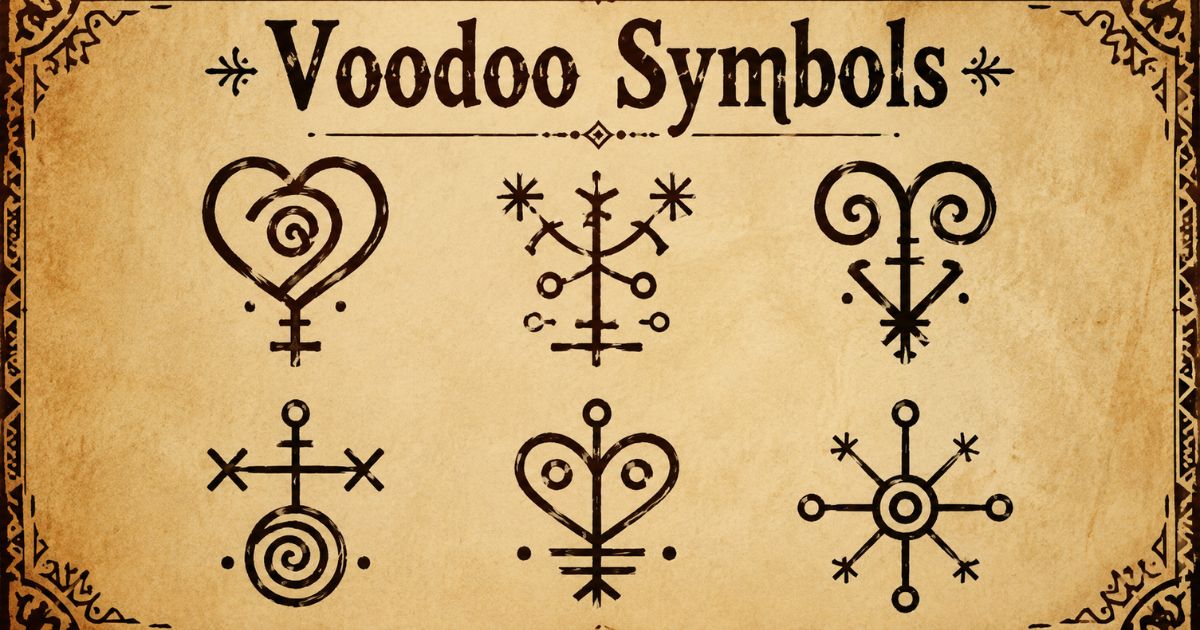
Authentic veve images are simple, linear, and geometric, drawn from memory by initiated priests (houngans) and priestesses (mambos), unlike the ornate “doll and pins” imagery Hollywood popularized.
Voodoo Symbols Alastor
Fans of the animated series Hazbin Hotel often search “Alastor voodoo symbols” because the character’s design borrows imagery inspired by real veve, including elements resembling Met Kalfou and Damballah Wedo. Practitioners have noted this oversimplifies a real, still practiced religion, so it’s worth enjoying the show while remembering that veve remain sacred to real people.
Voodoo Symbols for Love
Erzulie Freda’s heart shaped veve is the most recognized love symbol in Vodou, representing romance, beauty, and devotion.
Voodoo Symbols for Protection
Ogou Feray’s veve, built from crossed swords and machetes, is the most invoked protection symbol, called on for defense and strength during conflict.
Read More: Symbols of Freedom
Understanding Voodoo Symbols and Their Meanings
Every veve works on two levels at once: as a visual signature for a spirit, and as a spiritual instruction for how that spirit should be approached.
Voodoo Symbols and Meanings
Meaning attaches to the lwa first, the symbol second. Learning the spirit behind the sign is the real key to understanding it.
Vodou Symbols
“Vodou” is the correct spelling for the Haitian religion, while “voodoo” is the popular, Americanized spelling used in Louisiana and pop culture.
Symbols of Voodoo

Beyond veve, voodoo symbolism includes colors, numbers, snakes, crosses, and objects like gris-gris bags, all working together during the ceremony.
Voodoo Religion Symbols
As a recognized religion (the Haitian government formally acknowledged Vodou in 2003), its symbols function the way the cross does in Christianity: sacred, not superstitious.
Voodoo Religion Symbol
A single symbol, such as Legba’s crossroads cross, can summarize an entire spiritual philosophy about choice and destiny.
Voodoo Symbolism Religion Symbols
Voodoo symbolism blends African cosmology with Catholic saint iconography, born from centuries of forced religious disguise during slavery.
Voodoo Symbols and Their Meanings
Collecting accurate meanings in one place matters, since scattered, inaccurate information online has fueled decades of stereotypes.
Voodoo Symbols and Meaning
Respecting the meaning behind a voodoo symbol means recognizing it as someone’s genuine faith, not a costume or aesthetic prop.
Types of Voodoo Symbols Around the World
Voodoo is not one single tradition. It changed shape as it crossed oceans and generations.
Haitian Voodoo Symbols
Haitian Vodou has the richest, most codified veve system, with hundreds of documented symbols passed down through oral tradition inside temples called ounfo.
Haitian Voodoo Symbols and Meanings
Each Haitian veve layers meaning through shape: crosses for crossroads spirits, serpents for Damballah, hearts for Erzulie, and swords for Ogou.
African Voodoo Symbols

In West African Vodun, the ancestral source of the religion, symbols tend to be simpler geometric marks than the elaborate veve seen in Haiti, honoring the same spirit families under different names.
Louisiana Voodoo Symbols
Louisiana Voodoo, centered in New Orleans, blends Haitian veve with Hoodoo folk magic and Catholic saint imagery, often displayed alongside gris-gris charm bags.
New Orleans Voodoo Symbols
New Orleans made the gris-gris its signature symbol: a small pouch holding an odd number of herbs, stones, or personal items, associated with figures like Marie Laveau.
Veve Voodoo Symbols
A veve acts as a spiritual beacon. Drawing it with precision is considered an invitation the lwa cannot ignore.
Voodoo Veve Symbols and Meanings
Veve are drawn with cornmeal, wheat flour, or brick powder, poured carefully between the fingers so the pattern stays exact, since small design errors can change which spirit responds.
Protection, Signs and Special Voodoo Symbols
Protection is one of the most requested purposes behind any voodoo ritual.
Voodoo Protection Symbols
Ogou Feray and Papa Legba are the spirits most frequently called on for protection, whether for a person, a home, or a sacred space.
Voodoo Symbols of Protection
The Marasa (divine twins) veve is also used for protection, representing balance and the belief that two forces watching together are stronger than one.
Voodoo Symbol for Death
Baron Samedi’s cross and top hat imagery mark the threshold between worlds. His symbol is invoked for healing as often as for mourning.
Voodoo Hand Signs
Ritual hand gestures accompany veve during ceremonies, signaling respect, marking initiation rank, or directing ritual energy.
Voodoo Signs
Beyond drawn symbols, “signs” in Voodoo include dreams, animal behavior, and coincidences that practitioners read as messages from the lwa.
Voodoo Signs and Symbols
Together, signs and symbols form a complete spiritual language: one drawn and visible, the other lived.
Unique and Modern Voodoo Symbol Uses
Voodoovoodoo Symbols
Outside formal religious practice, modern spiritual communities have adopted voodoo inspired imagery for candle magic and altar work, though most recommend learning the real meaning first.
Voodoo Symbols PNG
Designers often search for transparent PNG veve graphics for tattoos and apparel. The more respectful approach is sourcing designs from Haitian or Vodou owned artists rather than generic clip art.
Alastor Voodoo Symbols
As mentioned above, Alastor’s design in Hazbin Hotel is the clearest example of veve inspired imagery entering mainstream animation, sparking useful conversations about cultural respect versus creative shorthand.
Deep Symbolic Meaning
On a Spiritual Level
A voodoo symbol is treated as a literal doorway, a way for a spirit to step from the invisible world into the ritual circle.
On a Psychological Level
Psychologically, these symbols work like any ritual object: they focus intention and give the mind a concrete anchor for abstract hopes like love or protection.
On a Cultural Level
Culturally, voodoo symbols preserve the memory of enslaved Africans forbidden from practicing their own religion, encoding survival and identity into every line.
Types and Variations of Voodoo Symbols
Some lwa are so central to Vodou that their veve appear in nearly every ceremony.
1. Papa Legba Veve
Legba’s veve features a cane and a cross marking the crossroads. He is saluted first, since he opens the gate between the human and spirit worlds.
2. Erzulie Freda Veve
Erzulie Freda’s heart shaped veve, often pierced or crowned, represents love, luxury, and emotional longing.
3. Baron Samedi Veve
Baron Samedi’s veve combines a cross with a coffin or skull motif, marking him as guardian of the dead and master of resurrection magic.
4. Damballa Veve
Damballa’s veve shows two intertwined serpents, symbolizing the primordial creator spirit tied to purity, wisdom, and the origin of life.
5. Ogou Veve
Ogou’s veve is built from crossed swords and machetes, representing his identity as a warrior spirit of fire, iron, and protection.
Voodoo Symbols Across Cultures
West Africa
In Benin, Togo, and parts of Nigeria, Vodun remains an unbroken ancestral religion, the root system every later branch grew from.
Haiti
Haiti transformed African Vodun into Vodou, the most symbol rich branch, officially recognized as a religion by the Haitian government in 2003.
Louisiana
Louisiana Voodoo absorbed Haitian refugee traditions after the Haitian Revolution, mixing them with Hoodoo and Catholic saint devotion.
Caribbean and Brazil
Sister religions like Cuban Santeria and Brazilian Candomble share the same West African roots and use comparable symbols for their own deities, called orishas.
Modern Global Spirituality
Today, veve inspired imagery appears worldwide in tattoos and altar art. Respectful practitioners encourage learning from real Vodou sources rather than pop culture alone.
Voodoo Symbols in Art, Movies and Pop Culture
Hollywood has shaped more misconceptions about voodoo symbols than any other single force. A few well known examples:
- Angel Heart and The Skeleton Key, which linked veve imagery to satanism and pin stuck dolls, neither reflecting real practice
- The Princess and the Frog and American Horror Story: Coven, which brought voodoo aesthetics to mainstream audiences
- Music, where Jimi Hendrix’s “Voodoo Chile” and Dr. John’s album “Gris-Gris” used voodoo language as mystique rather than doctrine
- Animation, where shows like Hazbin Hotel have reignited curiosity about veve
Each example raises the same question every generation asks: are we honoring this symbolism, or flattening it into a spooky trope?
Spiritual and Dream Meaning of Voodoo Symbols
Dreaming about voodoo symbols does not mean a curse is coming. In most spiritual interpretation traditions, dreaming of a veve or unfamiliar ritual sign suggests your subconscious is processing a need for guidance or closure, not an omen of danger. A snake filled dream may point to Damballah style themes of transformation. A heart shaped symbol often echoes Erzulie’s domain of unresolved love. Crossroads imagery tends to appear when a dreamer faces a real decision in waking life. Read symbolically, these dreams mirror the same themes voodoo symbols represent in ritual: choice, connection, protection, and change.
Positive vs Negative Meaning
Positive Meaning
Used respectfully, voodoo symbols represent healing, community, ancestral connection, and protection, exactly as they function within real Vodou practice.
Negative Interpretation
Used carelessly or through a Hollywood lens, the same symbols get flattened into “black magic” stereotypes that have historically fueled real world discrimination against practitioners.
Why Humans Are Attracted to Voodoo Symbols
People are drawn to voodoo symbols for the same reason any sacred sign pulls at curiosity: they promise access to something bigger than ordinary life. The geometric beauty of a veve, its mix of mystery and precision, satisfies a very human need for pattern and meaning.
Centuries of sensationalized storytelling only add to the pull, part fascination, part fear, part genuine spiritual searching. For many, exploring these symbols is really a search for agency: a way to feel protected, loved, or lucky inside an unpredictable world.
Conclusion
Voodoo symbols are far more than movie props or spooky aesthetics. They are living religious language, carried across oceans and centuries by people who refused to let their faith disappear. From Papa Legba’s crossroads to Erzulie’s heart and Baron Samedi’s cross, each veve tells a story about survival, spirit, and connection to something greater.
Understanding these symbols with accuracy and respect honors the millions who still practice Haitian Vodou, Louisiana Voodoo, and West African Vodun today. The next time a voodoo symbol crosses your path, whether in a documentary, a tattoo, or an animated character, you’ll see it for what it truly is: sacred, intentional, and deeply human.
