
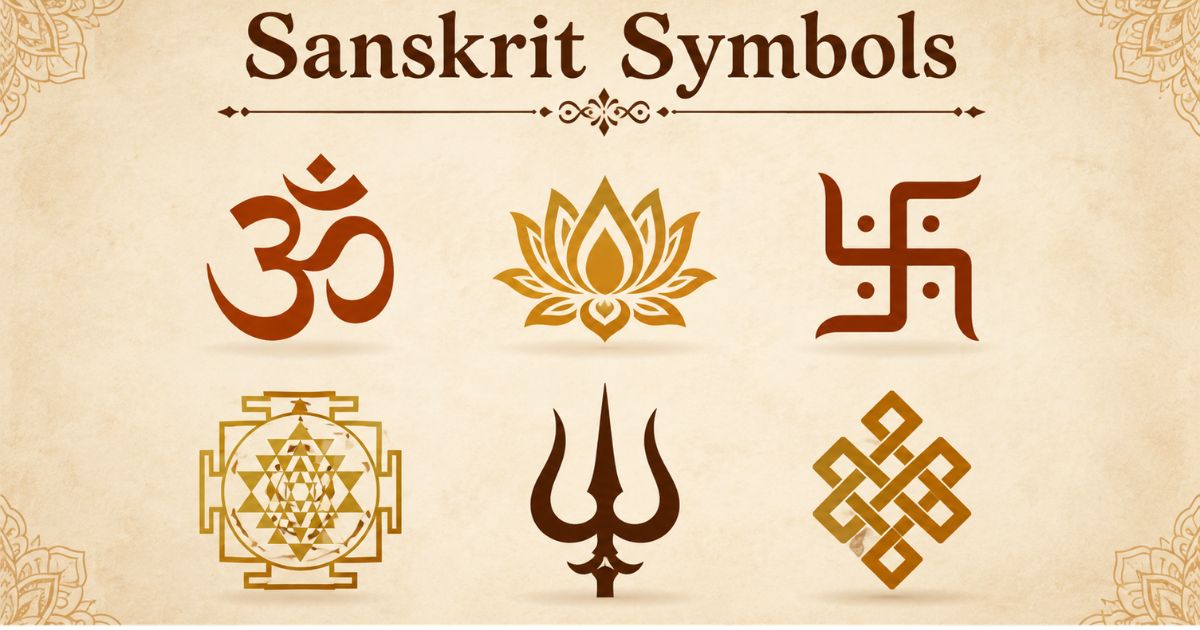

Sanskrit symbols have quietly moved from temple walls into yoga studios, tattoo parlors, and phone wallpapers. Part of that pull is visual: the curves of Devanagari script look like art on their own. But the bigger reason is meaning. Each symbol carries a compressed idea about the self, the universe, or the breath, and people in 2026 are looking for exactly that kind of grounding. This guide walks through what these symbols mean, where they come from, how they show up in tattoos and pop culture, and why the human brain keeps gravitating toward them.
What Are Sanskrit Symbols?
Sanskrit symbols are visual and phonetic signs rooted in one of the world’s oldest languages, written primarily in the Devanagari script. They are not just letters. Many function as sacred sound forms, known as mantras or bija (seed) syllables, believed to carry spiritual vibration rather than just meaning.
You will find them in three main forms:
- Written characters, such as individual Devanagari letters tied to specific sounds and energies.
- Sacred diagrams, like mandalas and yantras, that combine geometry with Sanskrit script.
- Iconic single symbols, such as Om, the lotus, or the swastika, that stand alone as spiritual shorthand.
These symbols appear in Hindu, Buddhist, and Jain traditions, and they show up in scripture, temple carvings, jewelry, and now, tattoos and digital art.
Ancient Sanskrit Symbols And Their Spiritual Meanings
Long before Sanskrit symbols became design trends, they were tools for prayer, protection, and philosophy. Understanding their original context makes the modern use far more meaningful.
Sanskrit Symbols And Meanings
Most Sanskrit symbols point toward a bigger idea than the mark itself suggests. Om represents the sound of the universe. The lotus stands for purity rising out of struggle. Dharma refers to duty and right living, while karma describes the law of cause and effect. Moksha means liberation from the cycle of rebirth, and shanti simply means peace.
Buddhist Sanskrit Symbols And Meanings
Buddhism shares Sanskrit roots with Hinduism and uses several of the same symbols with its own emphasis. The Dharma wheel represents the Buddha’s teachings and the path out of suffering. Nirvana signifies the end of craving and the release from cyclical existence. Ahimsa, the principle of non-violence, guides ethical conduct in both traditions. These symbols appear on prayer wheels, temple murals, and Tibetan thangka paintings.
Ancient Sanskrit Symbols
Some of the oldest Sanskrit symbols predate written history by centuries and appear in Vedic hymns composed more than 3,000 years ago. The Trishula, or trident, is linked to Shiva and represents creation, preservation, and destruction. The Sri Yantra, a geometric diagram of interlocking triangles, symbolizes the union of masculine and feminine cosmic energy. These forms were carved into temple stone long before they reached modern jewelry.
Sanskrit Symbol For Life

There is no single universal glyph labeled “life” in Sanskrit, but the concept is usually carried through words like Jeevan (life) or Prana (life force, vital breath). People often pair these words with the Om symbol to represent vitality, purpose, and the connection between body and spirit.
Sanskrit Symbols For Breathe
Breath-focused symbols center on the word Prana, meaning life-giving breath or vital energy. In yoga and pranayama practice, this concept is written or chanted as a reminder to slow down, breathe with intention, and stay present. It is one of the most requested tattoo translations for people recovering from stress or anxiety.
Read More: French Symbols
Popular Sanskrit Symbols In Tattoos And Modern Design
Sanskrit has become one of the most requested tattoo languages in the world, prized for its visual elegance as much as its meaning.
Sanskrit Symbols Tattoos
Tattoo studios report steady demand for single-word Sanskrit tattoos like Om, Shanti, and Satya (truth). Their compact, flowing script fits wrists, spines, and ribs without losing legibility, which is part of why they remain a top choice year after year.
Sanskrit Symbols And Meanings Tattoos
Before booking a tattoo, most people research the exact meaning behind their chosen word, since a small script error in Devanagari can completely change its meaning. Popular meaningful choices include Ananda (bliss), Bala (strength), and Jnana (wisdom).
Spiritual Sanskrit Symbols
Symbols chosen for spiritual rather than decorative reasons usually connect to a personal practice, such as a chakra symbol tied to a specific meditation goal or a mantra recited daily. These carry more weight for the wearer than purely aesthetic script.
Sanskrit Symbols Text
Digital creators frequently use Sanskrit text in quote graphics, wallpapers, and social captions to add a spiritual tone without needing a full tattoo commitment. Copy-paste Devanagari fonts have become common on Pinterest boards and Instagram bios.
Symbols Of Sanskrit
Beyond religious use, Sanskrit symbols now represent identity and heritage for many in the diaspora. Wearing or displaying them is often a way to stay connected to ancestry, even without daily religious practice.
Sanskrit Symbols Meaning
Context changes meaning significantly. Om worn on a yoga mat signals mindfulness, while the same symbol inked as a chest tattoo may signal a deeper personal transformation or life event.
Sanskrit Symbol For Balance

Balance is most often represented through the Ardhanarishvara concept (the union of Shiva and Shakti, masculine and feminine energy) or through the Yin-Yang-like symmetry found in mandala design. Samanjasya, the Sanskrit word for harmony, is also a common tattoo choice.
Breathe Sanskrit Symbol
As noted above, Prana is the go-to word for “breathe.” It is frequently paired with a lotus or a single Om stroke to visually suggest calm, controlled breathing.
Deep Symbolic Meaning
What separates Sanskrit symbols from generic decorative icons is layered meaning. Om, for instance, is not just a sound. Its three curves represent waking, dreaming, and deep sleep, while the crescent and dot above represent illusion and pure consciousness beyond ordinary states. A single symbol can hold an entire philosophical framework, which is why scholars and casual fans alike keep returning to the same handful of signs for deeper study.
Types / Variations of Sanskrit Symbols
Om Symbol
Om, sometimes written Aum, is considered the primordial sound from which the universe emerged. It is chanted at the start of most Hindu and Buddhist rituals and is the single most recognized Sanskrit symbol worldwide.
Lotus Symbol
The lotus, or Padma, grows out of muddy water yet blooms untouched by the mud. It symbolizes purity, spiritual awakening, and the human capacity to rise above hardship.
Swastika Symbol
In Sanskrit, swastika means “well-being” or “good fortune.” Long before its twentieth-century misuse, it was a sacred sign of prosperity in Hinduism, Buddhism, and Jainism, still drawn at weddings, temple entrances, and during Diwali. A clockwise swastika typically represents Surya, the sun, while a counterclockwise version relates to Shakti and tantric practice.
Chakra Symbols
The seven chakras (Muladhara, Swadhisthana, Manipura, Anahata, Vishuddha, Ajna, and Sahasrara) each carry a Sanskrit seed syllable, color, and element. They map energy centers running from the base of the spine to the crown of the head.
Mandala
Mandala means “circle” and represents the structure of the universe and the mind. Monks create elaborate sand mandalas and then dismantle them, a practice meant to teach impermanence rather than permanence.
Read More: Symbols of Hope
Sanskrit Symbols Across Cultures
While Sanskrit symbols originate in the Indian subcontinent, several have parallels or adopted meanings across other cultures. The lotus echoes Egyptian sun symbolism. The swastika appears in Native American, Baltic, and ancient Greek art, all independently tied to solar or cyclical themes.
Buddhism carried Sanskrit-rooted symbols like the Dharma wheel across Asia, adapting them into Tibetan, Thai, and Japanese spiritual art while keeping the original meaning largely intact.
Sanskrit Symbols in Art, Movies & Pop Culture
Sanskrit symbols regularly appear in film costume design, album covers, and streetwear, often used to signal spirituality, mysticism, or an “awakened” aesthetic. Mandala patterns show up in coloring books, phone cases, and wall art marketed for stress relief. Yoga branding worldwide leans on Om and lotus imagery almost by default.
This crossover has helped the symbols reach audiences who may never study Sanskrit directly, though it has also led to some symbols, particularly the swastika, being stripped of original context in Western media.
Spiritual & Dream Meaning of Sanskrit Symbols
In Hindu dream interpretation, or Svapna Shastra, dreaming about Sanskrit script or sacred symbols is generally read as a sign of deep introspection. Traditional interpreters associate it with a period of stepping back from social noise to focus on personal insight or hidden truths.
Classical texts like the Upanishads treat the dream state itself as one of four levels of consciousness, alongside waking, deep sleep, and turiya, or pure awareness. Modern dream dictionaries echo a similar theme, linking Sanskrit dream imagery to curiosity, self-reflection, and a pull toward knowledge others may have missed.
Positive vs Negative Meaning
Most Sanskrit symbols carry an overwhelmingly positive meaning tied to peace, wisdom, protection, or growth. The clearest exception is the swastika. Within Hinduism, Buddhism, and Jainism it remains a genuine symbol of good fortune and is used openly in religious life. In much of the Western world, however, it is strongly associated with Nazism due to its appropriation in the twentieth century.
This dual meaning is worth understanding before using the symbol outside a clearly religious or cultural context, since intent does not always translate across audiences. Other symbols rarely carry negative baggage, though misused or incorrectly translated tattoo text can unintentionally distort a word’s meaning.
Why Humans Are Attracted to This Symbol
Psychologically, humans are drawn to symbols that condense complex feelings into a single, memorable image, something psychologist Carl Jung described through the idea of universal archetypes shared across cultures.
Sanskrit symbols work well for this because they are visually simple, philosophically deep, and tied to practices like yoga and meditation that already promise calm and clarity. For many people, wearing or displaying one becomes a small daily anchor, a reminder of intention, identity, or a goal they are working toward, without needing to explain the entire philosophy behind it.
Conclusion
Sanskrit symbols endure because they do more work than ordinary decoration. A single character can carry a state of consciousness, a moral principle, or a reminder to breathe. Whether you are drawn to Om for its sound, the lotus for its resilience, or a chakra symbol for its focus, understanding the real meaning behind these signs makes them far more valuable than a passing trend. Approached with respect and accurate translation, Sanskrit symbols can genuinely support the kind of intentional, grounded life many people are seeking in 2026.
