
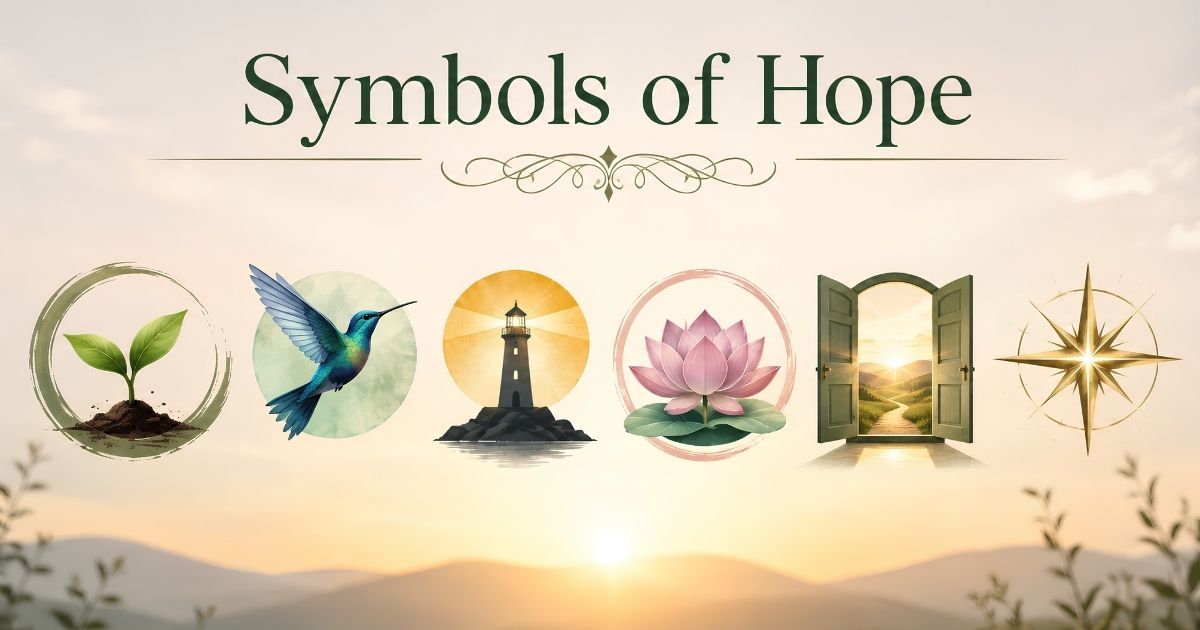

Hope has always needed a shape. Long before people had words for fear, loss, or longing, they turned to images: a bird carrying a branch, a sun breaking through storm clouds, a single candle in a dark room. These pictures became symbols of hope, and they still shape how we cope with hardship today.
This guide explores what hope symbols really mean, where they came from, how different cultures interpret them, and why the human brain is naturally drawn to them.
What Are Symbols of Hope?
Symbols of hope are images, objects, colors, or creatures that represent optimism, renewal, faith, and the belief that circumstances can improve. They act as visual shorthand for emotions that are difficult to put into words.
These symbols usually fall into a few categories:
- Natural symbols, such as the sun, rainbow, and seasons of growth
- Religious and spiritual symbols, such as the dove, cross, or lotus
- Animal symbols, such as the butterfly, phoenix, and crane
- Everyday objects, such as candles, anchors, and lighthouses
What unites them is emotional function. A hope symbol doesn’t just decorate a story or a tattoo; it reminds the viewer that darkness is temporary and renewal is possible, even when proof of that renewal doesn’t yet exist.
Deep Symbolic Meaning of Hope Symbols
Hope symbols carry meaning on three interconnected levels: spiritual, psychological, and cultural. Understanding all three explains why these images have survived for thousands of years.
Spiritual Meaning
In most faith traditions, hope symbols point toward something greater than the present moment. Light, wings, and sacred animals suggest that a higher power is present even during suffering. In Christianity, the dove and the cross represent grace and salvation. In Buddhism and Hinduism, the lotus represents the soul rising above hardship toward enlightenment. Across nearly every religion, the message is the same: pain is not permanent, and transformation is always within reach.
Psychological Meaning
From a psychological standpoint, hope symbols trigger a sense of safety in the brain. Familiar hopeful imagery, such as sunlight or an open sky, is linked to survival and progress, which is why hospitals and recovery programs often use calming visuals like butterflies or soft light. Psychologist Carl Jung described hope as an archetype rooted in the collective unconscious, meaning humans are wired to respond to certain images as reassuring, regardless of culture.
Cultural Meaning
Culturally, hope symbols act as a shared language during hardship. Communities recovering from war, disaster, or social change often rally around a single image, such as a flower, a bird, or a color, to express collective resilience. These symbols don’t require translation; a rainbow after a storm or a candle in a window communicates the same feeling in almost any language.
Decode This Symbol Now :Family Symbols in 2026
Types and Variations of Symbols of Hope
While hundreds of hope symbols exist worldwide, a handful appear again and again across history and art.
1. The Dove
The dove is one of the most universally recognized symbols of hope, largely due to the biblical story of Noah’s Ark, where a dove returned carrying an olive branch to signal that floodwaters had receded. Since then, it has represented peace, forgiveness, and new beginnings well beyond religious tradition, including modern peace movements.
2. The Rising Sun

A sunrise marks the end of darkness and the start of a fresh opportunity, which is why ancient civilizations linked it to life itself. Egypt’s sun god Ra, Greece’s Helios, and other sun deities were worshipped as bringers of renewal. Today, the rising sun still symbolizes fresh starts and the promise that difficult nights eventually end.
3. The Anchor
The anchor represents steadiness during uncertain times. Sailors relied on anchors to stay grounded through storms, and the symbol later became associated with unwavering faith, particularly within early Christian communities who used it as a discreet symbol of belief. Today, an anchor image often signals emotional resilience and the ability to stay steady through hardship.
4. The Butterfly
Few symbols capture transformation as clearly as the butterfly. Its journey from caterpillar to winged creature mirrors personal growth after struggle, which is why it’s frequently used in recovery and healing contexts. In several cultures, including Native American traditions, the butterfly is also linked to wishes and messages from a higher power.
5. The Candle
A single candle in darkness has long represented guidance, faith, and quiet resilience. Candles appear in religious ceremonies across Christianity, Judaism, and Hinduism as symbols of eternal hope and remembrance. One small flame refusing to go out is a powerful metaphor for persistence during difficult seasons.
6. The Rainbow
Appearing only after rain, the rainbow has become a global symbol of hope, harmony, and healing. In biblical tradition, it represents a divine promise of protection, while in modern culture, it also represents inclusion and unity. Its brief appearance after a storm makes it one of the most emotionally powerful hope symbols in nature.
Symbols of Hope Across Cultures
Hope symbolism isn’t confined to one belief system. It developed independently across civilizations, often producing strikingly similar meanings.
Ancient Egypt
Egyptians associated the sun with eternal renewal through the god Ra, believed to be reborn every morning. This daily cycle symbolized order, protection, and the promise that life continues beyond hardship.
Greek Civilization
In Greek mythology, hope is personified as Elpis, who remained inside Pandora’s box after every other evil escaped into the world. No matter how much suffering exists, hope is the one force that stays with humanity until the end.
Christianity
Christian tradition uses several hope symbols, including the dove, the cross, and the olive branch, together representing forgiveness, salvation, and the belief that suffering leads to eventual restoration.
Native American Cultures
Many Native American nations use the eight-pointed star, sometimes called Star Knowledge, to symbolize guidance and hope for the future. Animals such as the butterfly and eagle also carry spiritual significance tied to transformation.
Eastern Cultures
In China and Japan, the lotus flower represents rising above difficulty into purity, since it grows beautifully out of muddy water. Cherry blossoms, blooming briefly each spring, symbolize renewal and the fragile, hopeful nature of life.
Symbols of Hope in Art, Movies & Pop Culture

Storytellers rely on hope symbolism because it creates instant emotional connection with an audience. In film, birds and beams of light are frequently used to represent freedom after confinement or suffering, a technique seen in many acclaimed prison and survival dramas. Renaissance painters often used rays of light breaking through clouds to represent divine hope entering a scene.
In contemporary culture, hope symbols appear in awareness ribbons, tattoos, greeting cards, and social media graphics. The phoenix, a mythical bird reborn from its own ashes, has become especially popular in modern storytelling as a symbol for anyone rebuilding after total loss. Literature and visual art continue to lean on these timeless images because they communicate emotion faster than words can.
Spiritual & Dream Meaning of Symbols of Hope
When hope symbols appear in dreams, they’re often read as messages from the subconscious about healing or emotional change:
- Light or sunrise: clarity emerging after confusion
- A dove: forgiveness or peace entering your life
- A butterfly: personal transformation already in motion
- A rainbow: relief following a difficult emotional period
Many spiritual traditions view these dream symbols as gentle reassurance that a hard chapter is closing. Interpretations vary by culture, but the underlying theme stays consistent: something within you is shifting toward renewal.
Decode This Symbol Now :Timeless Symbols of Freedom
Positive vs Negative Meanings of Hope Symbols
Hope symbols aren’t always simple. Many carry dual meanings depending on context, which is part of what makes them emotionally rich.
| Symbol | Positive Meaning | Negative or Complex Meaning |
| Dove | Peace and new beginnings | Vulnerability or fragility |
| Sun | Life and renewal | Overwhelming intensity |
| Butterfly | Growth and transformation | Fragility of life |
| Candle or fire | Guidance and faith | Danger if left uncontrolled |
This duality is a reminder that hope rarely exists in isolation. It often sits alongside struggle, which is exactly why these symbols feel honest rather than overly sentimental.
Why Humans Are Attracted to Symbols of Hope
Humans are pattern-seeking beings, and from early childhood, people look for visual reassurance that circumstances can improve. This instinct is tied to survival: recognizing light, growth, and safety cues once helped early humans navigate real physical danger, and those same neural pathways now respond to symbolic versions of the same ideas.
There’s also an emotional component. A hope symbol gives people something tangible to hold onto when words feel inadequate, such as during grief, illness, or major life transitions. Because these symbols are shared across generations, they create a sense of belonging, a reminder that others have faced similar darkness and found their way through it.
Conclusion
Symbols of hope have guided humanity through war, loss, illness, and uncertainty for thousands of years, and they continue to do so today. Whether it’s a dove carrying an olive branch, a sunrise breaking through darkness, or a single candle refusing to go out, these images give shape to a feeling words alone often cannot express.
Hope doesn’t promise that hardship will disappear. What it offers is steadier: the quiet belief that better days are still possible, and the strength to keep moving toward them.
