
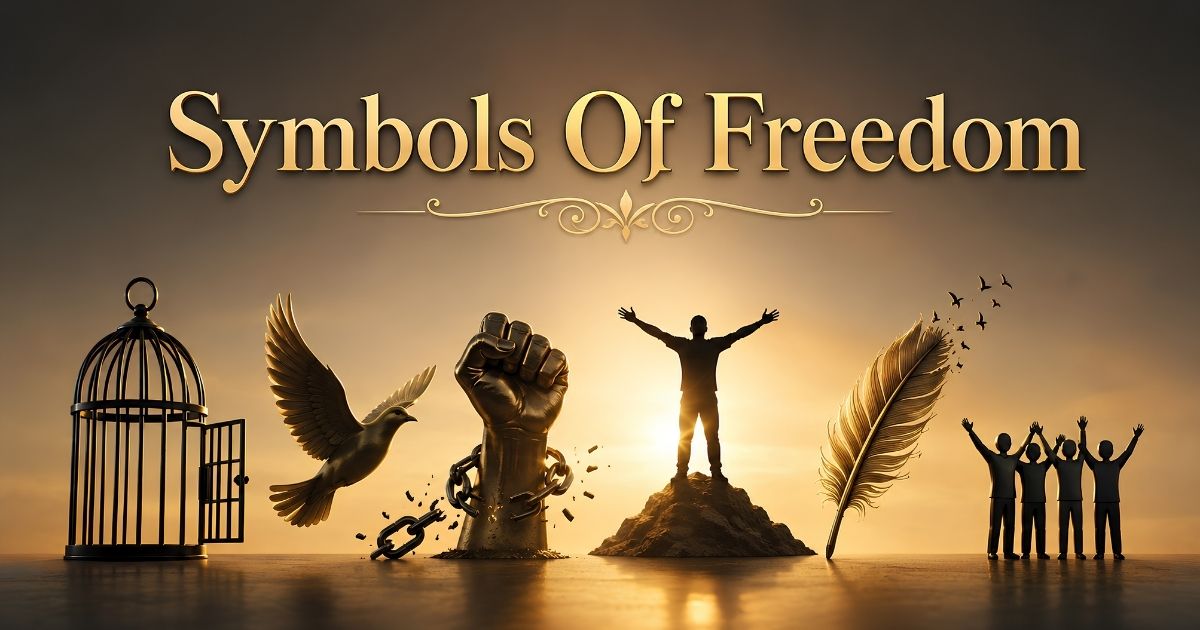

Freedom is one of the few ideas every culture on earth has tried to capture in a picture. Long before people could write their feelings down, they were already carving birds into stone, breaking chains in art, and raising torches into the sky to say one simple thing: we will not be held down. These images outlived empires, religions, and revolutions because they speak a language that does not need translation.
This guide walks through the most meaningful symbols of freedom, where they came from, what they mean in art, tattoos, dreams, and mythology, and why the human brain keeps returning to the same handful of images whenever it tries to picture liberation.
What Are Symbols of Freedom?
Symbols of freedom are visual, natural, or cultural images that stand for independence, liberation, and the absence of control. They show up in flags, animals, gestures, colors, and even everyday objects like an open road or a blank page.
A symbol earns this meaning through repetition. When enough people, across enough generations, use the same image to describe breaking free from oppression, it stops being random and becomes a shared shorthand. That is why a broken chain or a soaring eagle can communicate an entire history of struggle in a single glance, without a single word of explanation.
These symbols generally fall into a few categories:
- Natural symbols, such as birds, the open sky, and flowing water
- Man-made symbols, such as flags, keys, and monuments
- Mythological and spiritual symbols, such as the phoenix or the lotus
- Personal symbols, such as tattoos that mark an individual’s own journey toward freedom
See Also: Woman Symbols of Strength and Courage
Universal And Ancient Freedom Symbols
Universal Symbol Of Freedom
If there is one image that crosses almost every culture without translation, it is the bird in flight. A bird answers to no fence, no border, and no master, which is exactly why it has been adopted by ancient temples, modern tattoo studios, and protest banners alike. The dove, in particular, has become a near-universal marker of peace combined with freedom, recognized from Western religious art to Eastern folklore.
Ancient Symbols Of Freedom
Older civilizations relied on animals and objects that reflected strength alongside liberty. The phoenix, a bird said to rise from its own ashes, represented rebirth and the refusal to stay defeated. The eagle stood for fearless living and dominance over the skies. In ancient Rome, a soft felt cap called the pileus was placed on the head of a newly freed slave, turning a simple piece of fabric into a public declaration of emancipation.
These ancient freedom symbols still influence modern jewelry, coats of arms, and tattoo design because their meaning has never weakened with time.
Symbols Of Freedom In Mythology
Mythology gave freedom to a body and a story. In Greek mythology, Pegasus, the winged horse, represented limitless freedom through flight and imagination, often linked to poetic inspiration and the soul rising above earthly limits. Norse and Egyptian traditions carried similar figures, winged or supernatural beings who could not be caged by mortal rules. These stories were rarely about the animal itself; they were about a human longing to escape boundaries that felt too small.
Symbols Of Freedom Tattoos

Freedom tattoos remain one of the most personal ways people carry meaning on their skin. Flying birds, feathers, butterflies, and broken chains are common choices because each one tells a different chapter of a freedom story: escape, transformation, healing, or a fresh start. People often choose these designs after a major life change, such as leaving an unhealthy relationship, recovering from addiction, or starting over in a new place.
Tattoos That Symbolize Freedom
Beyond the classic bird or chain, several other designs are growing in popularity:
- Compass tattoos, representing direction and self-guided choice
- Open sky or cloud designs, symbolizing limitless possibility
- Wings without a bird body, suggesting the feeling of flight rather than a literal creature
- Wild horses or wolves, blending freedom with strength and independence
Freedom Symbol Tattoo
A single, well-chosen freedom symbol tattoo can say more than a sleeve full of imagery. Minimalist designs, such as one small bird in flight or a thin broken-chain line on the wrist, are popular precisely because they are quiet reminders rather than loud statements. The placement often matters too; chest and rib tattoos are frequently chosen for emotional or spiritual freedom, since they sit close to the heart.
Spiritual And Creative Freedom Symbols
Symbols Of Freedom In Art
Painters and illustrators have leaned on open doors, flying birds, sunlight breaking through clouds, and wide-open landscapes for centuries to express liberation. These compositions are rarely accidental. An open door pulls the eye toward possibility, while sunlight breaking through darkness mirrors the emotional shift from oppression to hope. Street art and protest murals continue this tradition today, using raised fists, broken locks, and unchained figures to comment on modern struggles for civil rights.
Spiritual Symbols Of Freedom

On a spiritual level, freedom rarely means the absence of rules; it means the absence of inner bondage. The lotus flower, sacred in Buddhist and Hindu traditions, rises clean and untouched out of muddy water, symbolizing freedom from suffering and attachment. Similarly, many spiritual traditions describe enlightenment itself as a form of ultimate freedom, the moment a person stops being controlled by fear, ego, or material desire.
Symbol Of Freedom Drawing
When people sketch their own symbol of freedom, certain shapes appear again and again: a bird mid-flight, an open cage with the door swinging wide, a single feather drifting in the wind, or a winding road disappearing into the horizon. These drawings are popular in journaling and art therapy because the act of drawing freedom can be just as healing as the symbol itself.
Symbols Of Freedom Not American
Freedom symbolism is far bigger than any single flag or national bird. Some powerful non-American examples include:
- The Adinkra symbol Fawohodie from the Akan people of Ghana, representing independence and self-determination
- The olive branch from ancient Greece, tying freedom to peace and civic life
- The lotus flower across Asian spiritual traditions, representing rising above suffering
- The Liberty Cap, later adopted during the French Revolution as a symbol of resistance against monarchy
- India’s spinning wheel, the charkha, which became a quiet but powerful emblem of self-reliance during the independence movement
Symbols Freedom
When people search simply for “symbols freedom,” they are usually looking for a quick, broad list rather than one deep explanation. The shortest answer: birds, broken chains, flags, keys, open roads, the sky, light, and water are the most universally recognized images, each tied to a different flavor of liberation, whether physical, emotional, or spiritual.
Read More: Leadership Symbols
Deep Symbolic Meaning
Spiritual Level
Spiritually, freedom symbolizes the release of the soul from fear, ego, and material attachment. Many traditions teach that real freedom is internal first; once a person stops being ruled by anxiety or desire, external circumstances lose much of their power over them.
Psychological Level
Psychologically, these symbols speak directly to a basic human need for autonomy. Seeing a bird in flight or a broken chain can trigger genuine feelings of empowerment because the brain associates the image with choice, movement, and control over one’s own path, even if the viewer’s actual circumstances haven’t changed.
Cultural Level
Culturally, freedom symbols act as rallying points. Flags, anthems, and protest icons unite strangers around a shared cause, turning individual hope into collective action during wars, civil rights movements, and revolutions.
Types / Variations of Symbols of Freedom
1. The Bird (Especially Eagle or Dove)
The eagle represents strength, vision, and dominance over the skies, which is why it became the United States’ national bird in 1782. The dove, by contrast, pairs freedom with peace, often shown carrying an olive branch.
2. Broken Chains
Few images carry as much raw emotional weight as a snapped chain. It marks the exact moment bondage ends, whether that bondage was slavery, addiction, an abusive relationship, or an oppressive system. This is why broken chains appear so frequently in protest art, recovery tattoos, and historical monuments.
3. The Open Road
A road stretching toward the horizon represents choice and self-direction. Unlike a bird or a chain, it doesn’t point to an escape from something; it points toward something, making it a popular symbol for people starting a new chapter in life.
4. The Butterfly
Because of its dramatic transformation from caterpillar to winged creature, the butterfly symbolizes personal change and the freedom that comes after a difficult transition. It’s a favorite choice for people who have come through grief, illness, or major personal growth.
5. The Flag
A flag turns freedom into a shared identity. Flown on independence days, at protests, and at memorials, it carries both pride and responsibility, reminding a community that freedom is something to actively protect, not just enjoy.
6. The Key
A key represents access and unlocked potential. It’s less about escaping confinement and more about opening a door to something new, whether that’s a literal new home or a fresh stage of life.
7. The Sky
The sky has no edges, no fences, and no owner, which makes it one of the purest images of limitless freedom. Photography, poetry, and film return to wide-open skies again and again to suggest possibility without boundaries.
Symbols of Freedom Across Cultures
Ancient Greece
Freedom was tied closely to democracy and civic participation. The olive branch represented peace alongside independence, and mythological figures like Pegasus reflected the soul’s desire to rise above limitation.
Ancient Egypt
Egyptian culture used winged deities and the image of the soul, often depicted as a bird, to express the idea that true freedom continued beyond physical life. Rising or ascending imagery was common in tomb art and religious texts.
Native American Cultures
Many Native American traditions treat birds, especially eagles, as spiritual messengers connecting earth to sky. The rising sun also carries symbolism of enlightenment and personal growth, suggesting that freedom is as much an internal journey as an external one.
Medieval Europe
During this period, freedom symbolism was often tied to release from servitude or feudal obligation. Caps and specific garments marked a person’s change in status, a visual cue that announced liberation to an entire community at a glance.
Modern Western Culture
Modern Western symbolism leans heavily on national icons: flags, monuments, anthems, and figures like the Statue of Liberty. These symbols combine historical memory with present-day civic identity, reminding citizens of both the cost and the responsibility of liberty.
Symbols of Freedom in Art, Movies & Pop Culture
Film and music have kept freedom symbolism alive for new generations. Songs about birds breaking free from cages, films built around open roads and escape narratives, and album covers featuring wings or broken restraints all draw from the same well of imagery that ancient cultures first established. Even modern logos and brand identities borrow these cues, an open door, a bird mid-flight, a key, because audiences instantly read them as hope, possibility, and independence without needing further explanation. Protest movements have also adopted modern symbols like the raised fist, which can represent solidarity and resistance depending on the context in which it’s used.
Spiritual & Dream Meaning of Symbols of Freedom
Dreaming about flying, open doors, or broken restraints is often interpreted as the subconscious mind processing a desire for change. A dream involving a bird escaping a cage, for example, may reflect a waking-life situation where someone feels trapped, whether in a job, relationship, or pattern of thinking. Spiritually, recurring freedom imagery in dreams is sometimes read as a sign that a person is ready to release old fears or outdated beliefs and step into a more authentic version of themselves.
Positive vs Negative Meaning
Positive Meaning
In most contexts, freedom symbols represent hope, courage, healing, and self-determination. They celebrate overcoming hardship and embracing a more authentic, unrestricted life.
Negative Meaning
The same symbols can carry heavier or more complicated meanings depending on context. A raised fist might suggest conflict rather than unity to some viewers, and broken chains, while triumphant, also serve as a permanent reminder of real suffering and oppression that should never be minimized or forgotten.
Why Humans Are Attracted to Symbols of Freedom
People are drawn to these images because autonomy is a basic psychological need, not a luxury. Across cultures, history, and personal experience, humans consistently resist control and seek out choice. Symbols of freedom give that internal drive a visible shape. They turn an abstract feeling, the desire to be unrestricted, into something a person can wear, paint, fly, or carry, which makes the longing feel less lonely and more shared.
Conclusion
Symbols of freedom are more than decoration. They are compressed history, carrying centuries of struggle, hope, and resilience into a single image that still resonates today. Whether it’s a bird breaking from its cage, a chain split in two, or a flag rising over a crowd, these symbols remind people everywhere that the desire to live without unnecessary limits is one of the most human things there is. Whatever symbol speaks to you personally, it likely reflects a story only you fully understand, and that makes it powerful in its own right.
