
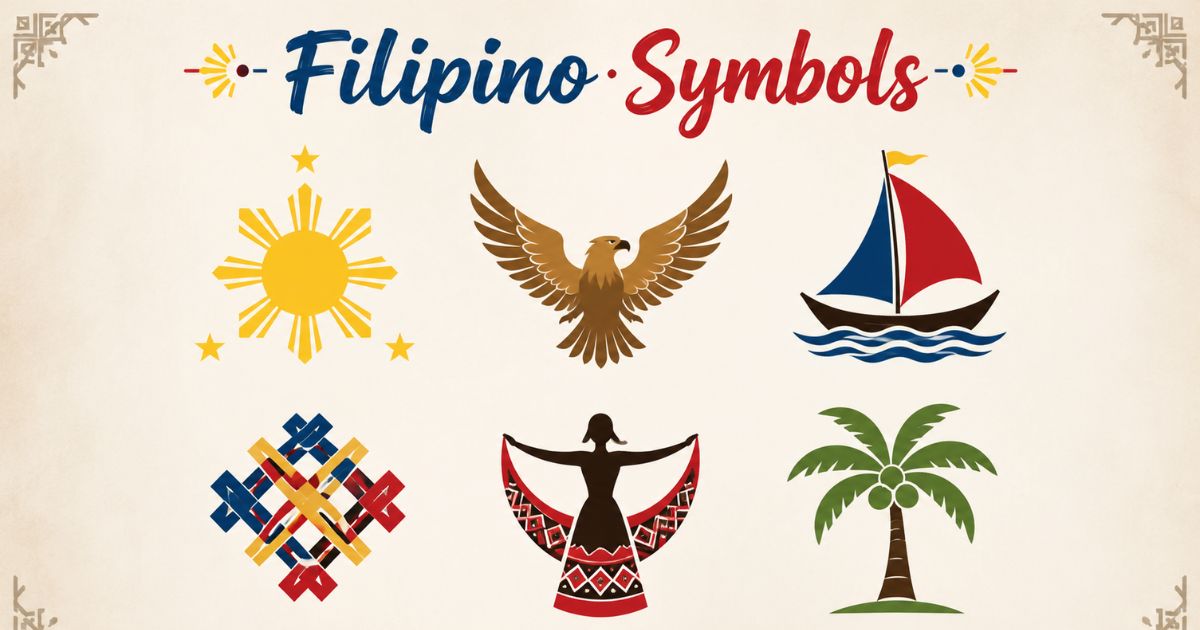

Filipino symbols are more than decoration. They are living records of a people’s history, spirituality, and identity, carved into gold, tattooed onto warrior skin, and written in scripts that predate Spanish colonization. From the golden sun on the flag to the mythical Sarimanok of Mindanao, these symbols carry meanings most people walk past without noticing.
This guide breaks down the hidden meanings behind Filipino symbols, from national emblems and ancient tattoos to indigenous scripts and spiritual beliefs, so you get clear, accurate answers in one place.
What Are Filipino Symbols?
Filipino symbols are visual, written, or artistic representations that carry cultural, spiritual, historical, or national meaning within Philippine society. They show up on the flag, in tribal tattoos, in weaving patterns, in ancient scripts, and in the carved figures once used to honor ancestors and nature spirits.
Long before the Philippines became a single nation, its many ethnic groups used symbols to express identity, rank, and belief. Some became official national emblems; others survived quietly in regional art and body markings, forming a layered visual language that still shapes Filipino identity today.
Filipino Cultural Symbols and Their Meanings
Filipino Flag
Adopted on June 12, 1898, the Philippine flag is one of the most symbolically dense national flags in the world. Its blue stripe stands for peace, truth, and justice; the red stripe represents patriotism and courage; and the white triangle symbolizes equality, honoring the Katipunan revolutionary movement.
Inside the triangle sits a golden sun with eight rays, one for each province that first rose up against Spain: Batangas, Bulacan, Cavite, Laguna, Manila, Nueva Ecija, Pampanga, and Tarlac. Three five-pointed stars mark the corners, representing Luzon, Visayas, and Mindanao.
A lesser known detail: the flag changes meaning by orientation. Red stripe on top signals war; blue on top signals peace.
Filipino Symbols In Tattoos

Long before tattoo machines existed, Filipino tattooing already carried deep meaning. Spanish colonizers called the heavily tattooed Visayans “Los Pintados,” or “the painted ones,” after encountering communities in Cebu, Leyte, Samar, and Bohol whose bodies were marked to record rank, bravery, and milestones.
In the Cordillera mountains, this survives as batok, the hand-tapped method kept alive by Kalinga elder Apo Whang-od and her apprentices. Traditional designs include centipede motifs believed to support healing, star and moon patterns for guidance, and geometric lines that once marked a warrior’s rank.
Filipino symbol tattoos remain popular today, especially among Filipino-Americans reconnecting with heritage. Practitioners generally recommend researching a design’s specific tribal origin rather than mixing motifs from unrelated groups.
Filipino Symbols In Letters: The Baybayin Script
Filipino symbol letters most often refer to Baybayin, the pre-colonial writing system used across Luzon and the Visayas before Spanish colonization began in 1565. The name comes from the Tagalog word “baybay,” meaning “to spell.”
Baybayin is an abugida, pairing each consonant with a vowel sound across 17 core characters: 14 consonants and 3 vowels. Spanish missionaries who documented it in the 1500s were reportedly surprised by how widespread literacy already was among ordinary people, not just the elite. Though it nearly disappeared under colonial rule, Baybayin has re-emerged in tattoos, fashion, school curricula, and even on current Philippine peso banknotes.
Read More: Voodoo Symbols
National Symbols Of The Philippines
The Philippines has one of the more extensive sets of national symbols in the world, some enshrined in law and others recognized only as tradition.
What Are The 10 National Symbols Of The Philippines
The most commonly cited official symbols:
- National Flag, the Watawat ng Pilipinas
- National Language, Filipino
- National Anthem, Lupang Hinirang
- Coat of Arms
- National Flower, Sampaguita
- National Tree, Narra
- National Bird, Philippine Eagle
- National Gem, Philippine Pearl
- National Martial Art and Sport, Arnis
- National Sign Language, Filipino Sign Language
Several unofficial symbols, including the carabao, mango, bahay kubo, jeepney, and adobo, are widely taught in schools without carrying legal status.
Philippines National Bird And National Tree
Declared national bird in 1995, the Philippine eagle is among the largest and rarest eagles on Earth, found only in Philippine rainforests and now critically endangered. The narra tree, declared national tree in 1934, is prized for its durable, reddish hardwood and often used as a metaphor for Filipino strength.
Ancient And Traditional Filipino Symbols
Ancient Filipino Symbols
Before colonization, Filipino communities expressed identity through symbols carved into wood and gold, woven into textiles, and etched into pottery. Archaeologists have found tattoo-like designs on burial pottery in Batangas, alongside gold ornaments from the Butuan and Surigao sites depicting protective motifs.
These ancient symbols were rarely decorative alone. A pattern on a shield, a house beam, or the skin usually recorded something specific: a family’s status, a warrior’s achievement, or a request for protection.
Filipino Good Luck And Protection Symbols

Sun motifs, animal carvings, and woven geometric patterns were widely believed to bring prosperity and ward off harm. The Sarimanok, a mythical bird from Mindanao’s Maranao culture, is one of the best known good luck symbols, said to bring fortune to whoever encounters it. Centipede tattoos in the Cordillera were believed to support healing, while certain markings on Kalinga women were meant to shield them from harmful spirits. Many of these protective designs are still requested today.
Indigenous Filipino Symbols By Region
The Philippines is home to more than 170 ethnolinguistic groups, so symbols vary widely by region. The Maranao and Maguindanao of Mindanao developed okir, a flowing, plant-based design style. The Kalinga, Ifugao, and Bontoc of the Cordillera each kept their own tattoo vocabulary, and Ilocano weavers produced their own nature-inspired motifs. No single “Filipino symbol” represents the whole country; the richness comes from these regional differences.
Read More: Sanskrit Symbols
Filipino Symbols Of Identity, Culture And Strength
Family Filipino Symbols And Meanings
Family remains central to Filipino identity. The bahay kubo, or nipa hut, represents simplicity and communal living, since homes were often built with neighbors’ help. Woven mats and baskets passed between generations symbolize continuity, and rituals like pagmamano echo the values of anito ancestor worship: family and obligation extend beyond the living.
Filipino Symbols For Strength
Warrior tattoos historically marked bravery in battle, with more elaborate designs signaling greater achievement. The narra tree symbolizes resilience, and the carabao, though never officially a national animal, is widely recognized for hard work after generations of plowing rice fields. Even the flag’s sun doubles as a symbol of strength, representing liberty won through struggle.
Symbols That Represent Filipino Culture Today
Modern Filipino identity draws on all of the above: the flag’s colors, the resilience of the narra and carabao, the artistry of Baybayin and okir, and the courage recorded in ancestral tattoos. Diaspora communities embrace these symbols as anchors to a homeland many have never lived in, wearing Baybayin jewelry or displaying the Sarimanok as a piece of home.
Filipino Symbols In Everyday Life And Practice

Beyond national emblems, several symbols and practices remain part of daily Filipino life:
- Pagmamano and pasintabi: rituals of respect toward elders and unseen spirits, rooted in anito belief
- Woven textiles: Ilocano abel cloth and Maranao malong fabric use geometric patterns tied to protection and status
- Warrior markings: batok tattoos functioned like a résumé, recording rank and milestones at a glance
- House architecture: carved beams like the Maranao panolong, adorned with okir, once signaled a family’s standing
- Harvest symbols: sun and grain motifs appear in festivals as thanks for a good harvest
These practices show Filipino symbolism was never purely decorative; it recorded status, belief, and history without a single written word.
Deep Symbolic Meaning of Filipino Symbols
Spiritual Level
Many Filipino symbols were believed to connect the living with anito and diwata, ancestor spirits and nature deities central to pre-colonial folk religion, acting as spiritual shields or invitations for balance between the human and spirit worlds. Even after conversion to Christianity, some persisted quietly in folk Catholic imagery.
Psychological Level
Symbols give people a sense of identity and belonging. Recognizing a familiar pattern, a tattoo motif or a flag color, creates an instant emotional connection to shared history, compressing colonization and migration into one easy-to-recognize image.
Cultural Level
These symbols preserve knowledge that might otherwise have been lost. Baybayin keeps a pre-colonial writing tradition alive, okir keeps Maranao craftsmanship visible, and batok keeps Cordilleran history on the skin rather than in a museum. Each is a small, portable record of a culture that colonization tried, and failed, to erase.
Types and Variations of Filipino Symbols
Sarimanok
A mythical, multicolored bird from Maranao folklore, often shown holding a fish in its beak. Traditionally placed atop a sultan’s umbrella or ceremonial pole, it represents good fortune and the connection between earthly and spiritual worlds, tracing back to a legend about Princess Sari.
Sun and Stars of the Philippine Flag
Detailed above, the sun and three stars remain the most reproduced Filipino symbols worldwide, appearing on currency, passports, and jerseys as shorthand for Filipino pride.
Anito Figures
Anito refers to ancestor spirits and nature deities in pre-colonial belief, as well as the carved figures, called taotao, used to represent them. In the Visayas and Mindanao, similar spirits are called diwata. A ritual known as pag-anito allowed a shaman, called a babaylan or katalonan, to communicate with these spirits.
Okir Patterns
A design system of flowing, plant-inspired curves developed by the Maranao, Maguindanao, and Tausug peoples of Mindanao. Found on ship prows, house beams, and textiles, okir divides into okir a dato, bolder masculine patterns, and okir a bai, softer feminine ones. The Sarimanok and serpent-like naga are its most recognizable figures.
Baybayin Script
Covered in detail earlier, Baybayin remains one of the most searched Filipino symbol systems online, thanks to its popularity in tattoos, jewelry, and modern Filipino branding.
Filipino Symbols Across Cultures
Many Filipino symbols share roots with wider Austronesian and Southeast Asian traditions. Baybayin belongs to the Brahmi-derived family of scripts found across South and Southeast Asia, diwata traces to the Sanskrit “devata,” and okir’s flowing motifs echo Islamic arabesque design. This layering makes Filipino symbolism a record of contact and exchange, not isolation.
Filipino Symbols in Art, Movies and Pop Culture
Filipino symbols have moved well beyond museums. Baybayin appears on the peso, in tattoo studios worldwide, and in streetwear brands aimed at the diaspora. Apo Whang-od’s magazine cover appearance brought global attention to batok and inspired a new generation of Filipino-Americans to seek ancestral designs, while regional festivals built around the Sarimanok and okir keep showcasing these symbols to wider audiences.
Spiritual and Dream Meaning of Filipino Symbols
In Filipino folk belief, certain symbols in dreams carry meaning. A sun is sometimes read as a sign of awakening. Dreaming of ancestral figures or anito is often read as guidance or an unresolved family matter, while a Sarimanok is traditionally linked to incoming good fortune. These come from oral folklore rather than science, so they’re best understood as living tradition, not literal prediction.
Positive vs Negative Meaning
Most Filipino symbols carry both light and shadow. The same tattoo that represents bravery also marks the violence that earned it. The Coat of Arms, with its American bald eagle and Spanish-inspired lion beside the Philippine sun, celebrates independence while acknowledging the colonization that shaped it.
Positively, Filipino symbols represent unity, resilience, and spiritual balance. Negatively, some carry memories of war or cultural loss. This duality reflects an honest history, and it’s why these symbols feel meaningful rather than merely decorative.
Why Humans Are Attracted to Filipino Symbols
People are drawn to symbols that tell a story: survival against colonization, deep family bonds, and an unbroken connection to nature and ancestors. For diaspora Filipinos, they offer a portable link to a homeland that can feel distant. For outsiders, the appeal often comes from craftsmanship: the lines of okir, the mystery of Baybayin, and the history behind every batok tattoo.
Conclusion
Filipino symbols are far more than eye-catching designs. They’re a living archive of a nation’s spirituality, resistance, and identity, stretching from the golden sun on the flag to the ancestral spirits once carved into wood, from the flowing lines of okir to the quiet resilience of a tattoo passed down for generations.
Understanding these symbols means understanding a bigger story: pre-colonial belief systems, regional diversity, colonization, and an ongoing cultural revival with no sign of slowing down. Whether you’re exploring your own roots or simply curious about Philippine culture, these symbols offer a rewarding starting point, one hidden meaning at a time.
