
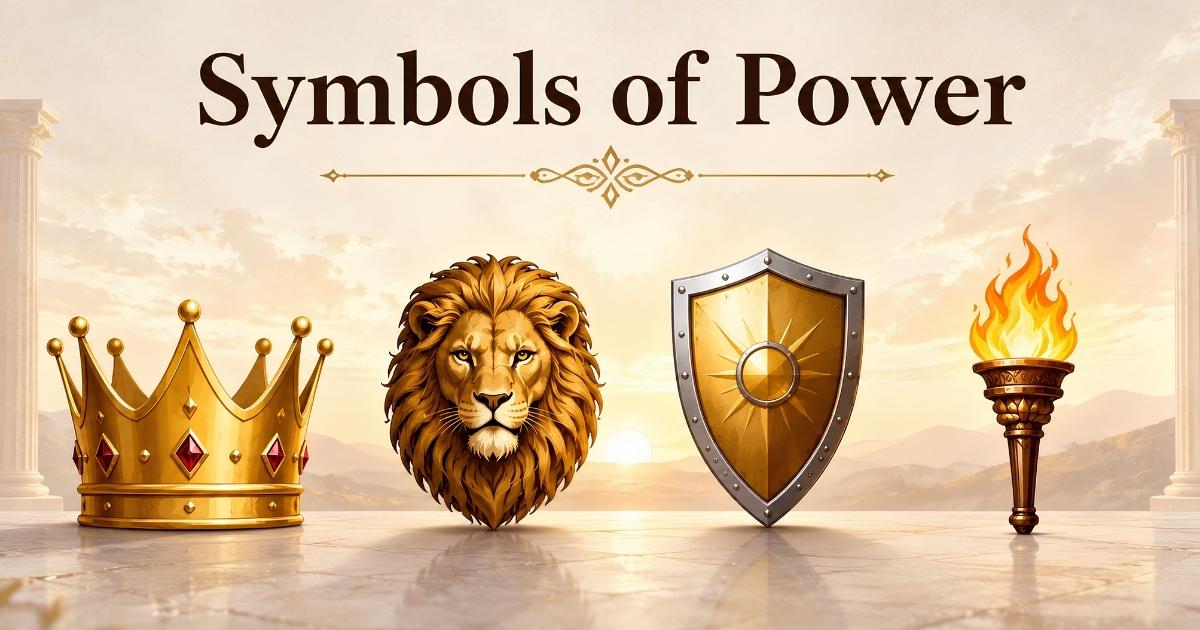

Power has never needed words to speak. A crown, a throne, a lion carved into ancient stone, these images carry weight that has outlasted entire empires. Long before written language, humans reached for symbols of power to explain authority and rank without saying a word. This article breaks down what these symbols mean, where they came from, and why the human mind still responds to them so strongly today.
What Are Symbols of Power?
Symbols of power are visual or physical markers, such as objects, animals, gestures, or shapes, that a community links with authority, control, or influence. They are not powerful on their own. A crown is only metal and gemstones until a culture agrees it represents the highest seat of rule.
That shared agreement, repeated across generations, turns an ordinary object into a lasting emblem of dominance. These symbols show up in flags, logos, uniforms, religious art, and royal regalia. Once a society accepts a symbol’s meaning, it works instantly, with no explanation needed.
Deep Symbolic Meaning
Symbols of power operate on more than one level at once. To understand why they affect people so deeply, it helps to look at three layers: spiritual, psychological, and cultural.
Spiritual Level
Many cultures believed objects like crowns, scepters, and sacred animals carried a divine charge that connected a ruler to a higher power. Ancient kings were seen as a bridge between heaven and earth.
Psychological Level
The human brain is wired to react to visual cues of status and threat. Sharp shapes like swords signal danger, while elevated symbols like thrones and crowns trigger an instinctive sense of hierarchy, often before conscious thought catches up.
Cultural Level
Every civilization builds its own vocabulary of authority. A color, animal, or object that signals strength in one culture can mean something entirely different elsewhere. Context shapes how a symbol is read, even when the underlying feeling of power is universal.
Read More: Superhero Symbols
Types / Variations of Symbols of Power

Some symbols of power appear again and again throughout history because they tap into instincts that rarely change. Here are eight of the most recognized.
1. Crown
A crown signals rulership and divine right. Worn on the head, the body’s highest point, it visually places the wearer above everyone else. Crowns still appear in branding and fashion today as shorthand for luxury and status.
2. Throne
More than furniture, a throne represents a fixed seat of judgment and rule. Sitting above others, both literally and symbolically, has marked authority since the earliest recorded kingdoms.
3. Lion
Known across Africa, Europe, and Asia as the king of beasts, the lion stands for courage, dominance, and protective strength. It appears on royal crests, national emblems, and countless coats of arms.
4. Eagle
Associated with vision, freedom, and command of the skies, the eagle has represented empires from Rome to the modern United States. Its height and hunting precision made it a natural fit for national symbols of authority.
5. Sword
A sword represents the power to defend, conquer, or enforce law. It is both a tool of protection and a warning, which is why it appears in coronation ceremonies, coats of arms, and justice imagery.
6. Scepter
Carried by monarchs during ceremonies, the scepter is a ceremonial staff that represents control over a kingdom. Its long, straight form echoes the idea of a stable, unbending rule.
7. Dragon
In Western myth, the dragon often represents a danger to be conquered. In Chinese tradition, it means the opposite: imperial authority, wisdom, and good fortune. The same creature carries almost opposite meanings depending on where it appears.
8. Pyramid
A pyramid’s wide base and narrow peak mirror how power is structured, with broad support at the bottom and a single point of authority at the top. In ancient Egypt, pyramids linked pharaohs to the divine, and the shape still appears today in currency, architecture, and corporate hierarchy charts.
Symbols of Power Across Cultures
The objects change from region to region, but the instinct to mark authority through symbols is universal.
Ancient Egypt
Pharaohs carried the crook and flail to show guardianship over the land. The pyramid and the sun disk reinforced their role as a link between gods and people.
Ancient Rome
The eagle standard, known as the aquila, led Roman legions into battle and represented the empire’s reach. The laurel wreath and the toga marked senators and generals as men of rank.
China
The dragon, along with imperial yellow and gold, marked emperors as heaven’s chosen rulers. The dragon throne became one of the most closely guarded symbols in Chinese history.
Medieval Europe
Crowns, scepters, coats of arms, and castle towers defined feudal rank. Heraldry turned symbols into a visual language that identified families, loyalty, and land ownership at a glance.
Modern Society
Corporate logos, military rank insignia, national flags, and luxury car badges now carry the same psychological weight older royal symbols once held. Power has changed hands many times, but the visual language of authority has barely changed.
Symbols of Power in Art, Movies & Pop Culture

Filmmakers and artists lean on symbols of power because audiences read them instantly. A crown on a villain signals corrupted rule. A lion in a fantasy story hints at a noble bloodline. A throne room shot, even without dialogue, tells viewers exactly who holds control.
Superhero franchises use similar shorthand, with capes and elevated stances borrowed from centuries-old royal imagery. Brand logos, from wing shaped car badges to fashion houses using crowns, tap into the same instinct that once marked kings.
Read More: Leadership Symbols
Spiritual & Dream Meaning of Symbols of Power
In dream interpretation, symbols of power rarely point to literal ambition. A crown in a dream often reflects a desire for recognition or a fear of losing control. A pyramid can represent personal growth, a climb from a stable foundation toward one clear goal. A throne may signal a need to reclaim authority over some part of life, while a sword can point to an inner conflict that needs a decisive choice.
Spiritually, these symbols are less about ruling others and more about self mastery, order, and direction. Many traditions read them as messages about a dreamer’s own untapped potential rather than literal power over people.
Positive vs Negative Meaning
Every symbol of power carries two sides, and context decides which one shows up.
Positive Side
Used well, these symbols represent leadership, protection, discipline, and earned respect. A crown can honor wisdom and service, while a throne can represent responsibility rather than privilege.
Negative Side
The same symbols can represent tyranny, fear, and control without accountability. A crown worn by a corrupt ruler becomes a symbol of oppression, and a sword used to conquer turns strength into violence.
Why Humans Are Attracted to Symbols of Power
Humans are drawn to symbols of power because they represent survival, safety, and belonging. For most of history, standing close to power meant protection and access to resources, and that instinct never fully disappeared.
On a personal level, these symbols also reflect something inward: a desire to rise, to be seen, and to matter. People do not just admire crowns and thrones from a distance. They want to feel the confidence those symbols represent, even in small everyday ways.
Conclusion
Symbols of power endure because they compress ideas like authority, strength, protection, and legitimacy into a single image the mind can process instantly. From ancient pyramids to modern logos, the objects change with each era, but the need to visually mark rank and control stays constant. Understanding these symbols is not only about history or design. It is about recognizing the quiet, universal language that has shaped how humans see leadership, strength, and each other for thousands of years.
