
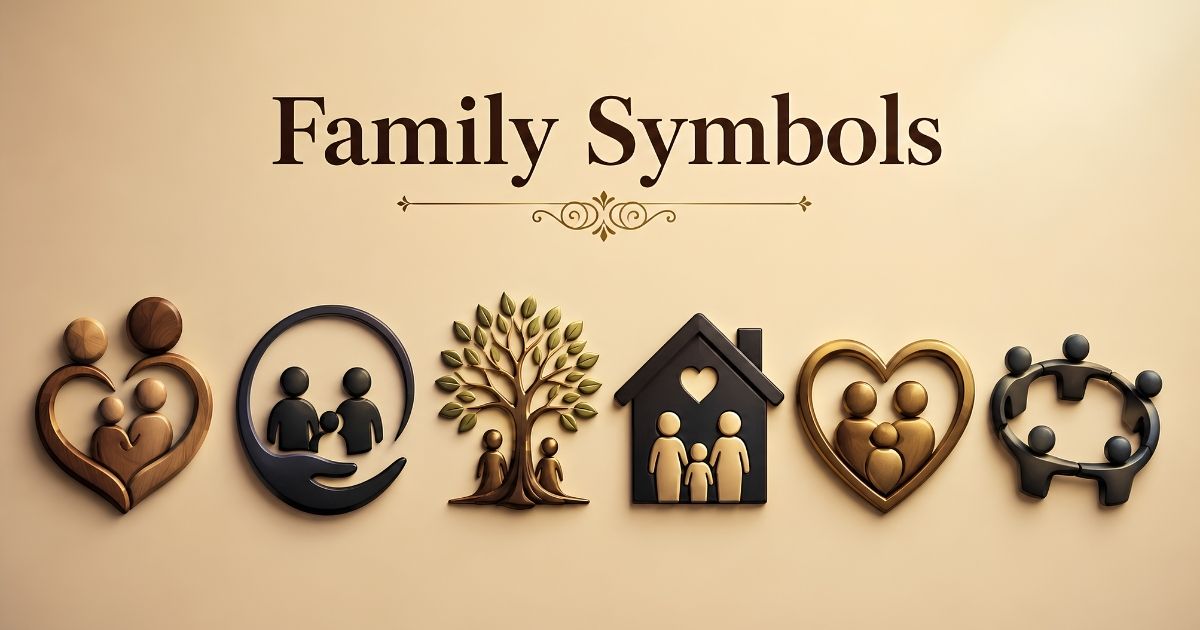

Long before written language existed, people were already telling the story of family through pictures. A circle scratched on stone, a knot tied into rope, a tree carved into wood. These were not random doodles. They were early attempts to capture something words could barely hold: the bond between parent and child, sibling and sibling, ancestor and descendant.
In 2026, family symbols are everywhere again. They show up in tattoos, jewelry, home decor, wedding invitations, and even app icons. But most people who wear or display these symbols don’t actually know where they came from or what they truly mean beneath the surface. This guide breaks down the spiritual, psychological, and cultural layers of family symbols, explores their most popular types, and explains why humans across every era have reached for the same visual language to describe one universal feeling: belonging.
What are Family Symbols?
Family symbols are visual marks, objects, or designs used to represent kinship, unity, ancestry, and emotional connection. They communicate identity without needing a single word, which is why they have survived across thousands of years and hundreds of cultures.
These symbols are not limited to blood relatives. Modern usage includes chosen families, blended households, and close friendships that function like family. A symbol earns its meaning through the relationship it represents, not through a strict bloodline rule.
You will typically see family symbols used in:
- Tattoos and body art
- Wedding rings and heirloom jewelry
- Coats of arms and family crests
- Home decor, wall art, and engraved keepsakes
- Religious art and architecture
- Modern logos, monograms, and digital icons
What makes them powerful is repetition. Every time a symbol is worn, displayed, or passed down, it reinforces a shared story that connects generations who may never meet face to face.
Read More: Nature Symbols
Deep Symbolic Meaning of Family Symbols
Family symbols are rarely just decoration. They operate on three distinct levels at once, and understanding all three gives a fuller picture of why these images matter so much to people.
Spiritual Meaning
On a spiritual level, family symbols often represent ancestral protection and generational continuity. Many belief systems hold that ancestors remain spiritually present, watching over the living branches of the family line. Symbols like the tree of life or interlocking knots are frequently used to suggest that no family member is ever truly disconnected from those who came before.
In several traditions, displaying a family symbol is treated almost like an invitation for ancestral guidance, a way of saying the past is still woven into the present.
Psychological Meaning
Psychologically, humans are wired for attachment. From infancy, the brain searches for cues of safety, belonging, and identity, and family symbols tap directly into that wiring. Seeing or wearing a familiar emblem can trigger feelings of comfort and emotional grounding, similar to how a childhood scent or song can instantly transport someone back to a safe memory.
This is also why family symbols are common choices for memorial tattoos or grief jewelry. They act as a physical anchor during emotionally unstable periods, offering a sense of continuity when life feels uncertain.
Cultural Meaning
Culturally, family symbols express heritage, status, and shared values. A coat of arms once signaled a noble bloodline. A tribal mark once identified clan membership at a glance. Today, the same instinct continues through monograms, family mottos, and customized crests that blend multiple cultural backgrounds into one new design.
Across all three layers, spiritual, psychological, and cultural, the underlying message stays consistent: family symbols exist to make an invisible bond visible.
Types / Variations of Family Symbols
Some symbols have become globally recognized shorthand for family. Here are five of the most meaningful and widely used.
1. Family Tree Symbol

The family tree is arguably the most universal symbol of kinship. Roots represent ancestry and origin, the trunk represents shared struggles and strength, and branches represent the spread of future generations. It is a visual timeline that works whether you are explaining lineage to a child or designing a memorial piece for a grandparent.
2. Claddagh Symbol
Originating in Ireland, the Claddagh shows two hands holding a heart topped with a crown. The hands represent friendship, the heart represents love, and the crown represents loyalty. While often associated with romantic relationships, it is also widely used in Irish families to represent loyalty between relatives across generations.
3. Knot Symbols (Celtic Knots)
Celtic knots, including the well-known Trinity Knot or Triquetra, use continuous interwoven lines with no clear beginning or end. This endless pattern is often read as a symbol of eternal connection, representing a family bond that cannot be broken or unraveled, regardless of distance or time.
4. Heart Symbol
Simple, universal, and instantly understood, the heart represents love, compassion, and emotional closeness. Unlike many culturally specific symbols, the heart needs no translation. It appears in family crests, tattoos, jewelry, and home decor across nearly every culture on earth.
5. Tribal Family Symbols
Many indigenous and tribal cultures used animal totems, such as wolves, bears, or turtles, to represent family traits like loyalty, protection, wisdom, or strength. These symbols often carried practical meaning too, marking which clan a person belonged to during gatherings, trade, or conflict.
Decode this symbol: Symbols of Friendship
Family Symbols Across Cultures

Ancient Egyptian Culture
Egyptian art frequently depicted family units through hieroglyphics showing parents and children together, often emphasizing protection from deities. Household gods and guardian symbols were commonly used to bless and protect the family unit within the home.
Celtic Culture
Celtic communities placed heavy emphasis on land, lineage, and survival through cooperation. While there was no single official Celtic family symbol, the Triquetra became closely associated with eternal family bonds, representing the connection between mind, soul, and heart, or alternatively life, death, and rebirth.
Chinese Culture
In Chinese culture, the character 家 (jiā) represents both “family” and “home,” reflecting how inseparable these two concepts are in Chinese tradition. Ancestor veneration plays a major role here, with family symbols often tied to respect for elders and continuity of the household name.
Native American Culture
Many Native American tribes used animal totems, such as the turtle for wisdom and longevity or the deer for gentleness, to represent different family roles. Circular designs, including the protection circle, were also common, symbolizing unbreakable family ties and spiritual defense of the household.
African Traditions
Across West Africa, Adinkra symbols are widely used to represent lineage, wisdom, and shared identity within a family or community. Many African cultures also use tribal marks, which historically identified which family or clan a person belonged to simply by appearance.
Family Symbols in Art, Movies & Pop Culture
Storytellers have always leaned on family symbols to communicate meaning quickly and emotionally.
- Movies: Family heirlooms, crests, or trees often foreshadow legacy, inheritance, or destiny in film narratives.
- Paintings: Artists frequently use trees, joined hands, or circles to visually represent generational unity.
- Books: Fictional family crests are often used to define noble houses, alliances, or ancestral power struggles.
- Tattoos: One of the most popular modern uses, family symbol tattoos represent love, memory, and permanent emotional connection.
- Fashion and jewelry: Brands frequently use hearts, knots, and trees in collections designed around love and connection.
These recurring images succeed because audiences instantly recognize the emotional shorthand, no lengthy explanation needed.
Spiritual & Dream Meaning of Family Symbols
Seeing family symbols in dreams is often interpreted as a message about emotional security or unresolved feelings. A family tree appearing in a dream may suggest reflection on heritage or personal growth. A broken or incomplete symbol, such as a cracked heart or severed knot, can reflect anxiety about distance, conflict, or loss within the family.
In many spiritual traditions, dreaming of ancestral symbols is interpreted as a sign of guidance, almost as if departed family members are reaching out through imagery rather than words.
Positive vs Negative Meaning of Family Symbols
Positive Meaning
- Represents unity, loyalty, and unconditional love
- Provides emotional comfort and a sense of belonging
- Honors ancestry and preserves cultural heritage
- Strengthens identity, especially during major life transitions
Negative Meaning
- Can symbolize obligation, pressure, or unmet expectations
- May represent grief when used to memorialize a lost family member
- Can trigger painful memories in cases of estrangement or trauma
- Sometimes appropriated or distorted from its original cultural meaning
Context always determines interpretation. The same knot or tree can feel comforting to one person and heavy with sadness to another, depending on personal history.
Why Humans Are Attracted to Family Symbols
The pull toward family symbols is not just sentimental, it is rooted in basic human psychology. People are biologically wired to seek attachment, safety, and identity from the earliest stages of life. Family symbols offer a shortcut to all three at once.
In an increasingly digital and fast-moving world, where relationships can feel scattered across cities, countries, and time zones, a physical or visual symbol becomes an anchor. It says: I belong somewhere, and that connection is permanent, even when life feels uncertain. This explains why family symbol tattoos, custom jewelry, and personalized home decor have only grown in popularity rather than fading with time.
Conclusion
Family symbols have survived for thousands of years because they solve a problem language alone cannot fully solve: how do you visually express love, loyalty, and belonging in a single glance? From ancient Celtic knots to modern minimalist tattoos, the format keeps evolving, but the emotional core stays exactly the same.
Whether you choose a tree, a heart, a knot, or a symbol tied to your own cultural roots, what matters most is the meaning you and your family attach to it. In 2026, as families continue to look different from one generation to the next, these timeless symbols remain one of the simplest and most powerful ways to say: we are connected, and we always will be.
