
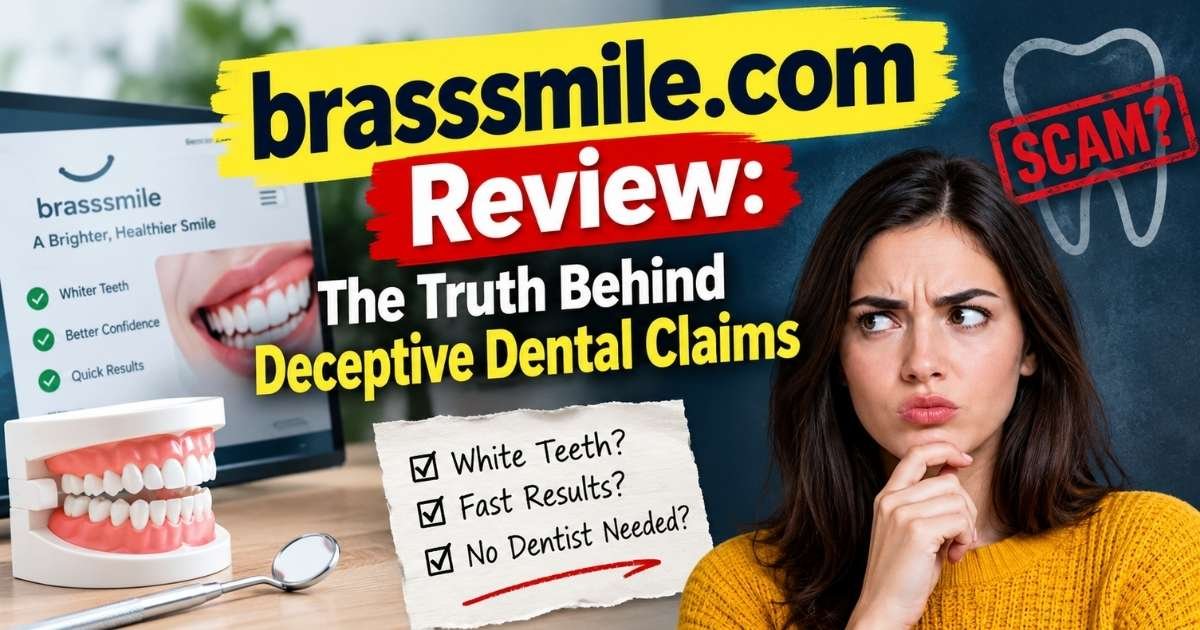

Searching for brasssmile.com often brings up confident claims about braces, whitening and “overnight smile makeovers.” Many of these claims come from third-party blogs, not from any verified dental provider. This review separates marketing language from facts you can check yourself.
The name brasssmile.com suggests a dental clinic, an orthodontic tool or a booking service. Public information points to something different, and sources disagree with each other. This guide explains what the site appears to be, why it confuses people, how to check its safety, and where to find dental advice you can trust.
What Is brasssmile.com? (Dental Hub vs General Blog)
Sources describe the name in three conflicting ways.
- A dental hub. Several blog posts present “BrassSmile” as a high-tech dental platform with 3D imaging, CAD/CAM design and medical-grade materials. These posts name no dentist, license number or address. Many are near-identical copies on unrelated websites.
- An at-home smile product. Other pages claim a “smart-porcelain” system gives permanent results in minutes. No clinical study, regulatory approval or manufacturer is cited. Treat this claim with caution.
- A general blog. At least one site audit describes the domain as an advert-funded publishing site covering gadgets, business and daily living, with no dental service behind it.
A separate site on a different domain presents itself as an independent braces information source. It says it does not sell braces or own clinics. That is a different address, so do not assume it belongs to the same owner.
The practical takeaway is that no verified evidence shows the domain operating a licensed dental practice. Until a provider shows credentials, assume it is not one.
Deconstructing the “Dental Clinic” Illusion: Why Is brasssmile.com Confusing?
The confusion comes from a mix of branding, search habits and copied content. Words like “smile” and “brass” push readers toward braces and orthodontics. The brain fills in a clinic, even when the page shows none.
Search results add to the problem. Many pages repeat the same promotional text across unrelated websites. When the same paragraph appears on a security consultancy site, a business software site and a science blog, it is usually automated or syndicated content, not independent confirmation.
Four warning signs appear repeatedly in these pages:
- No named dentist or orthodontist
- No licensing body or registration number
- No clinic address or phone number
- Bold promises such as “permanent results overnight”
1. The Orthodontic Software & Booking Myth
Some pages imply that the domain offers orthodontic software, treatment planning or online appointment booking. No credible evidence supports this.
Real dental software vendors publish product documentation, privacy policies, data protection terms and customer support channels. Real booking platforms show participating clinics and let you confirm each one.
Use this short test before trusting any dental platform:
- Can you find a named, licensed professional?
- Is there a verifiable business address?
- Does a privacy policy explain how health data is handled?
- Can the clinic be found on an official dental registry?
If the answer to any of these is no, do not enter personal or medical details.
2. The Mirror Domain & Typo-Squatting Risk
Typo-squatting means registering a name close to a known one, such as a different extension or a slightly altered spelling. The goal is to catch visitors who mistype or follow a wrong link.
Lookalike names are a real concern here. Variants exist on other extensions, including “.it.com” addresses that host different content. A visitor may believe every page belongs to one brand when the owners are unrelated.
Always read the full address in your browser bar. A different ending can mean a different owner, different content and different risk.
See Also: YonoSamachar Com: Explore News, Finance, and More Today
Mirror Domains & Search Rumors
A mirror domain is a separate website that copies, imitates or redirects to another. Mirrors are not always malicious, but they make it hard to know who is responsible for the content.
Rumors about this name grow in a predictable way:
- A low-quality article makes a bold dental claim.
- Other sites copy it with minor edits.
- Search tools pick up the repeated text and treat it as widely confirmed.
- Readers see the same claim many times and assume it is true.
Repetition is not verification. Real validation comes from independent, accountable sources such as professional dental associations, government health agencies or peer-reviewed research.
Here is how to handle rumors about this domain:
- Check who published the claim and whether they are named.
- Look for a source that is not a copy of the same text.
- Search the claim together with words like “scam,” “licensed” or “complaint.”
- Be most suspicious of claims about “permanent” or “instant” dental changes.
Claim vs Reality Breakdown
The table compares common claims found online with what can be reasonably confirmed.
| Claim found online | What can be verified | Risk level |
| It is a licensed dental clinic | No named practitioners or licenses found | High if you rely on it |
| It offers orthodontic software | No product documentation or vendor details found | Medium |
| It sells braces or aligners | No verified store, pricing or medical oversight found | High |
| It gives permanent results in minutes | Not supported by dental science or clinical evidence | High |
| It is a general content website | Matches at least one independent audit | Low for casual reading |
| Related sites are the same brand | Different domains may have different owners | Medium |
Real dental treatment needs an examination, a diagnosis and a licensed provider. Orthodontic work moves teeth slowly because bone and tissue need time to adapt. Any promise of an overnight, permanent change should raise concern.
Technical Infrastructure & Security Audit
This section explains what to look for. Technical details can change, so confirm them yourself using the tools named below.
WHOIS Privacy & Domain Registration Status
WHOIS records show who registered a domain, when, and through which registrar. Many owners now hide personal details behind a privacy service. This is common and legal, and it is not proof of wrongdoing.
Privacy becomes a concern only when combined with other warning signs, such as no company name, no contact details and aggressive health claims.
Check these points using the ICANN lookup tool (lookup.icann.org):
- Registration date. Very new domains deserve more caution.
- Registrar. Established registrars respond to abuse reports.
- Expiry date. Short registrations can signal a temporary project.
- Name servers. These show where the site is hosted.
SSL Encryption & Malware Scanning
An SSL certificate encrypts data between your browser and the website. The padlock icon confirms the connection is encrypted. It does not confirm the owner is honest, because even malicious sites can hold valid certificates.
Run these checks:
- Confirm the address begins with “https://”.
- Click the padlock and review the certificate issuer and dates.
- Scan the address with Google Safe Browsing’s Transparency Report.
- Use a reputable scanner such as VirusTotal to check for flagged content.
Treat scan results as a snapshot. A clean result today does not guarantee safety later.
Ad Network Risk Profile
Ad-funded sites earn money per visit, so they have a strong incentive to attract clicks. Ad networks can occasionally serve low-quality or misleading ads, including fake download prompts or “health” offers.
Reduce your exposure with these habits:
- Do not click pop-ups, notification requests or “update required” banners.
- Block third-party trackers with your browser’s privacy settings.
- Keep your browser and operating system updated.
- Never enter payment or health details on an ad-supported page.
Is brasssmile.com Safe to Browse?
For casual reading, the risk looks low to moderate. Read the pages, but do not act on them for dental decisions.
Follow these rules:
- Do not share medical history, photos of your teeth or payment details.
- Do not buy any “smile” product advertised through the site.
- Do not install files or apps offered on its pages.
- Use updated security software and a modern browser.
- Close any page that asks for notification permissions.
Staying safe also means protecting your health. Using unverified products on your teeth can damage enamel or gums. A dentist should assess changes to your teeth before any treatment starts.
Pros & Cons of brasssmile com
| Pros | Cons |
| Free to read | No verified dental authority |
| General topics can be informative | Dental claims lack evidence |
| No known paid dental service to pay for | Name suggests a clinic that does not appear to exist |
| Simple to browse on most devices | Ad-supported content may include misleading ads |
| Related braces information site states its editorial standards | Lookalike domains cause confusion over ownership |
The balance is clear. The site may be fine as casual reading, but it is a poor source for health decisions. The content that does cover dental topics should be treated as marketing until a named, qualified source supports it.
See Also: BrumeBlog Com Review 2026: What You Need to Know About the Website
Verified Alternatives for Dental Health & Authentic Tech News
Use sources that name their authors, cite evidence and show how they are funded.
Certified Dental & Health Authorities
- American Dental Association (MouthHealthy.org). Patient guidance reviewed by dental professionals.
- American Association of Orthodontists (aaoinfo.org). Information on braces and a tool for finding orthodontists.
- NHS (nhs.uk). Clear UK-based guidance on dental care and treatment.
- Pakistan Dental Association and the Pakistan Medical and Dental Council (PMDC). Check a dentist’s registration before booking.
- World Health Organization (who.int). Global oral health facts.
- Mayo Clinic and Cleveland Clinic. Reviewed articles on teeth, gums and orthodontic options.
Before booking any dentist, confirm their registration with your national council. Ask for a written treatment plan with costs.
Verified Technology & Lifestyle Outlets
- BBC Technology. Reliable general reporting.
- Reuters Technology. Fact-focused news.
- The Verge and Ars Technica. In-depth consumer tech coverage.
- Wired. Analysis of technology and culture.
- Consumer Reports. Independent product testing.
Good outlets share a pattern. They name authors, correct errors publicly and separate advertising from reporting. Apply the same standard to every website you read.
Conclusion
The name brasssmile.com promises more than the evidence supports. No verified source shows a licensed clinic, orthodontic software or a real treatment service behind it. Sources conflict, many are copied text, and lookalike domains add confusion.
Here is a simple action plan:
- Treat the site as casual reading only.
- Never share health or payment details.
- Verify any dentist through your national dental council.
- Use recognized health authorities for treatment decisions.
- Check the full web address before trusting any page.
Your teeth need a qualified professional, not a clever domain name. If a claim sounds too fast or too perfect, step back and verify it first.
FAQs
Is brasssmile.com a real dental clinic?
No verified evidence shows a licensed clinic behind the name. Sources conflict, so confirm any provider through an official dental registry.
Is brasssmile.com safe to open?
Casual reading appears low to moderate risk, mainly from ads. Avoid downloads, pop-ups and entering personal details.
Does brasssmile.com sell braces or aligners?
No trustworthy store, pricing or medical oversight could be confirmed. Buy orthodontic products only through a licensed provider.
Who owns brasssmile.com?
Ownership is not clearly disclosed in public sources. Check the registration record at lookup.icann.org, though privacy services may hide details.
Are similar domains like brasssmile.it.com the same website?
Not necessarily. Different extensions can have different owners and content, so verify each address separately.
Can a smile product really give permanent results overnight?
No. Permanent changes to teeth need professional assessment and time. Claims of instant, permanent results should be treated as unreliable.
Where can I find a trustworthy orthodontist?
Use your national dental council or the American Association of Orthodontists directory. Confirm credentials and request a written treatment plan.
