
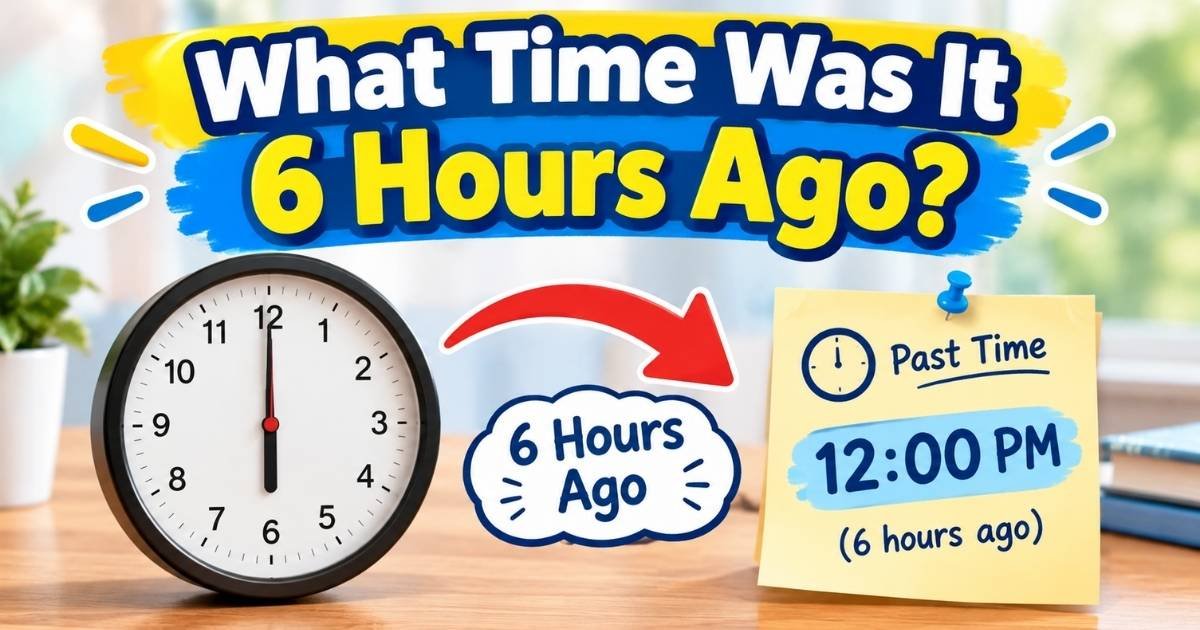

What time was it 6 hours ago? The answer takes seconds to work out, but a small slip with AM, PM, or the date can make it wrong.
To find what time it was 6 hours ago, subtract six hours from your current local time. Then check whether you crossed midnight, because that changes the date as well.
This guide shows the exact method, real examples, and the mistakes to avoid. You will also learn how time zones, clock formats, and daily routines affect the result.
Understanding What Time Was It 6 Hours Ago
“Six hours ago” is a relative time. It points to a moment exactly 360 minutes before right now. The answer changes every minute because “now” keeps moving.
A fixed clock time, like 3:00 PM, stays the same for everyone using that clock. A relative time, like six hours ago, depends on when you ask. If you ask at 9:00 PM, the answer is 3:00 PM. If you ask at 9:30 PM, it is 3:30 PM.
Six hours is also a quarter of a full day. That makes it easy to reason about. Subtracting six hours moves you back one quarter of the clock cycle.
How to Calculate 6 Hours Ago
You only need three steps. Follow them in order and you will get the right answer every time.
Step 1: Check the Current Time
Start with your exact current time. Look at the hour, the minutes, and AM or PM if you use a 12-hour clock.
Use the time on your phone or computer, since both sync with accurate time servers. Note the date too. You will need it in Step 3.
Step 2: Subtract Six Hours
Subtract 6 from the hour. Leave the minutes exactly as they are.
| Current Time | Subtract 6 Hours | Result |
| 2:15 PM | 2 – 6 | 8:15 AM |
| 11:40 AM | 11 – 6 | 5:40 AM |
| 7:05 PM | 7 – 6 | 1:05 PM |
If the hour is smaller than 6, you need to wrap around the clock. Add 12 to the hour first, subtract 6, then switch between AM and PM. For example, 4:00 AM becomes 16:00 on the 24-hour scale. Subtract 6 and you get 10:00 PM on the previous day.
Step 3: Check Whether the Date Changes
If your current time is before 6:00 AM, going back six hours crosses midnight. The answer falls on the previous day.
For example, if it is 2:30 AM on Thursday, six hours ago was 8:30 PM on Wednesday. Always state the day when it matters, especially for records, reports, or deadlines.
Why People Search “What Was 6 Hours Ago From Now”
People search this phrase because they need a fast, exact answer without mental math. Most are in the middle of a task and want to confirm a time quickly.
Common reasons include:
- Checking when an event, message, or alert occurred
- Verifying the time of a dose, meal, or nap
- Matching logs, receipts, or timestamps to a real clock time
- Planning around a team member in another time zone
- Confirming whether something happened today or yesterday
Voice assistants and AI answer engines now handle this question often. Clear, direct answers help them return accurate results, which is why a simple method matters.
See Also: How Long Until 2:00 PM?
Everyday Situations Where Time Six Hours Earlier Matters
Six hours is a common window in daily life. It covers half a shift, a medication gap, or a long stretch of sleep.
Work Shifts
Many shifts run 6, 8, or 12 hours. Knowing the time six hours back helps managers confirm when a worker started, when a break was due, or when overtime began.
It also helps with handovers. If a night nurse finishes at 7:00 AM, the six-hour mark tells you what has happened since 1:00 AM.
Medication Schedule
Some medicines are taken every six hours. Looking back six hours helps you confirm when the last dose was due.
Always follow your doctor’s or pharmacist’s instructions first. Use time math only as a reminder, not as a replacement for medical advice.
Sleep Tracking
Adults need roughly seven to nine hours of sleep. Counting back six hours from your wake time shows when your sleep must start to reach a minimum block.
If you wake up at 6:30 AM, six hours earlier is 12:30 AM. That gives you a clear latest bedtime for a basic sleep window.
Customer Support
Support teams track response times. A ticket opened six hours ago may be close to breaking a service agreement.
Agents use this calculation to prioritize older requests. It also helps when reviewing chat logs or call records by clock time.
Flight Schedules
Airlines list departure and arrival in local time. Travelers often check what happened six hours before takeoff or landing to match check-in, security, and delay notices.
When flights cross time zones, calculate in one zone first. Then convert to the other.
Time Arithmetic Made Simple
Time math feels harder than normal math because clocks do not use base 10. Hours wrap at 12 or 24, and minutes wrap at 60.
Here are three simple rules:
- Subtract hours only. Do not touch the minutes.
- If the result goes below 1 (12-hour) or 0 (24-hour), wrap around the clock.
- If you wrapped past midnight, move the date back by one day.
A quick shortcut also helps. Subtracting 6 hours equals subtracting 12 and adding 6. If you find that easier, use it. For example, 3:00 PM minus 12 hours is 3:00 AM, and adding 6 hours gives 9:00 AM. That matches 3:00 PM minus 6 hours? No. The shortcut works as 15:00 minus 6, which equals 9:00. Keep it simple and subtract directly for the safest result.
Examples Using Both 12-Hour and 24-Hour Clock
Both clock formats work the same way. The 24-hour clock is easier because it has no AM or PM.
12-Hour Clock
| Current Time | Six Hours Ago | Date Change |
| 10:20 AM | 4:20 AM | Same day |
| 6:00 PM | 12:00 PM | Same day |
| 3:45 AM | 9:45 PM | Previous day |
| 12:10 PM | 6:10 AM | Same day |
Watch the noon and midnight points. 12:00 PM is noon, and 12:00 AM is midnight. Mixing these up is a common source of errors.
24-Hour Clock
| Current Time | Six Hours Ago | Date Change |
| 14:30 | 08:30 | Same day |
| 06:00 | 00:00 | Same day |
| 02:15 | 20:15 | Previous day |
| 23:50 | 17:50 | Same day |
On this clock, add 24 when the hour goes negative. For instance, 02:00 minus 6 gives negative 4. Add 24 and you get 20:00 on the previous day.
What Time Will It Be in 6 Hours?
This is the reverse question. Instead of subtracting, you add six hours to the current time.
The same rules apply. Keep the minutes unchanged, wrap around the clock when needed, and move the date forward if you pass midnight.
| Current Time | Six Hours Later | Date Change |
| 9:00 AM | 3:00 PM | Same day |
| 8:30 PM | 2:30 AM | Next day |
| 17:15 | 23:15 | Same day |
| 21:00 | 03:00 | Next day |
Use this when planning meetings, deliveries, or reminders. Many people confuse the two directions, so say “ago” or “from now” clearly when you share the result.
Time Zones Can Change Everything
Your six-hours-ago answer is only correct in your own time zone. Someone in another region will see a different clock time for the same moment.
For example, when it is 3:00 PM in London, it is 10:00 AM in New York during standard time. Six hours earlier is 9:00 AM in London and 4:00 AM in New York.
Keep these points in mind:
- Always name the time zone when you share a time
- UTC is a neutral standard that many systems use
- Daylight saving time can shift clocks by one hour
- Not every country observes daylight saving time
Daylight saving changes can make “six hours ago” feel off. If the clocks changed in the last six hours, the real elapsed time and the clock difference may not match. In that case, count actual elapsed hours, or use UTC to avoid confusion.
Technology Depends on Accurate Time Calculation
Modern systems rely on precise time math every second. Servers, apps, and networks all record events with timestamps.
Examples include:
- Banking systems logging transactions
- Security tools flagging logins from the past six hours
- Analytics dashboards filtering “last 6 hours” data
- Delivery apps estimating arrival windows
- Email and messaging platforms showing “sent 6 hours ago”
Most software stores time in UTC and converts it to your local time for display. This avoids errors caused by time zones and daylight saving. Developers use this practice to keep data consistent across regions.
Using an Hours Ago Calculator
An hour ago the calculator does the math for you. You enter the number of hours, and it returns the exact past time and date.
These tools are helpful because they handle three things well. They adjust for midnight, they respect your device’s time zone, and they account for daylight saving changes.
To use one correctly:
- Confirm the calculator uses your local time zone
- Enter 6 as the number of hours
- Read both the time and the date in the result
- Double-check the result if daylight saving changed recently
Your phone’s clock app, search engine, or voice assistant can also give you this answer instantly. Manual math is still useful when you have no device handy or need to verify a result.
See Also: How Long Until 3:35?
Common Mistakes People Make
Most errors come from rushing. A few simple checks prevent them.
Forgetting the Date
If you go back past midnight, the day changes. People often write the correct time but the wrong date. Always check whether your answer falls on yesterday.
Mixing Up AM and PM
Switching between AM and PM at the wrong point gives a 12-hour error. Remember that the label flips when you cross 12:00 in either direction.
Changing the Minutes
Six hours is a whole number of hours. The minutes stay the same. If it is 4:47 PM now, six hours ago was 10:47 AM, not 10:17 AM.
Ignoring Time Zones
A time without a zone is incomplete. If you are working with people in other regions, state the zone or use UTC.
Confusing Six Hours Ago With Six Hours From Now
“Ago” means past, and “from now” means future. Reversing them gives an answer that is off by twelve hours. Read the question twice before you calculate.
Why Relative Time Feels Different From Exact Time
Relative time is easier to say but harder to verify. “Six hours ago” sounds clear, yet it depends on when the sentence was spoken or written.
A message that says “posted 6 hours ago” becomes inaccurate as soon as time passes. Exact time, like “posted at 9:15 AM UTC,” stays correct forever. This is why records, contracts, and logs prefer exact timestamps.
Our brains also treat the two differently. We understand relative time as distance from now, which feels natural. Exact time requires us to read a clock and compare, which takes more effort.
For everyday chat, relative time works well. For anything you must prove or revisit later, write down the exact time, the date, and the time zone.
Conclusion
Finding the time six hours ago is easy once you follow a clear routine. Check your current time, subtract six hours, and confirm whether the date changed. Keep the minutes the same, watch AM and PM, and name your time zone when it matters.
Use a calculator or your phone for speed, and use manual math to double-check. Doing this correctly helps with work logs, medication reminders, travel plans, and technical records.
Next time you ask yourself what the time was six hours back, you will have a fast and reliable answer in just a few seconds.
Frequently Asked Questions
How do I find the time 6 hours ago quickly?
Subtract six from the current hour and keep the minutes the same. Then check if the result crosses midnight and adjust the date.
What time was it 6 hours ago if it is now 3:00 PM?
Six hours before 3:00 PM was 9:00 AM. It was on the same day.
Does 6 hours ago always fall on the same date?
No. If your current time is before 6:00 AM, six hours falls on the previous day. Always check for a midnight crossing.
How do I calculate 6 hours ago on a 24-hour clock?
Subtract 6 from the hour. If the result is negative, add 24 and move the date back one day.
Does daylight saving time affect the answer?
Yes, it can. If clocks changed in the last six hours, the clock difference may not match real elapsed time, so use UTC to be sure.
What is the difference between 6 hours ago and 6 hours from now?
“Ago” means the past, so you subtract six hours. “From now” means the future, so you add six hours.
Can I use my phone to find the time 6 hours ago?
Yes. Search “6 hours ago” in your browser or ask your voice assistant. You can also use the time zone tools in your clock app.
