
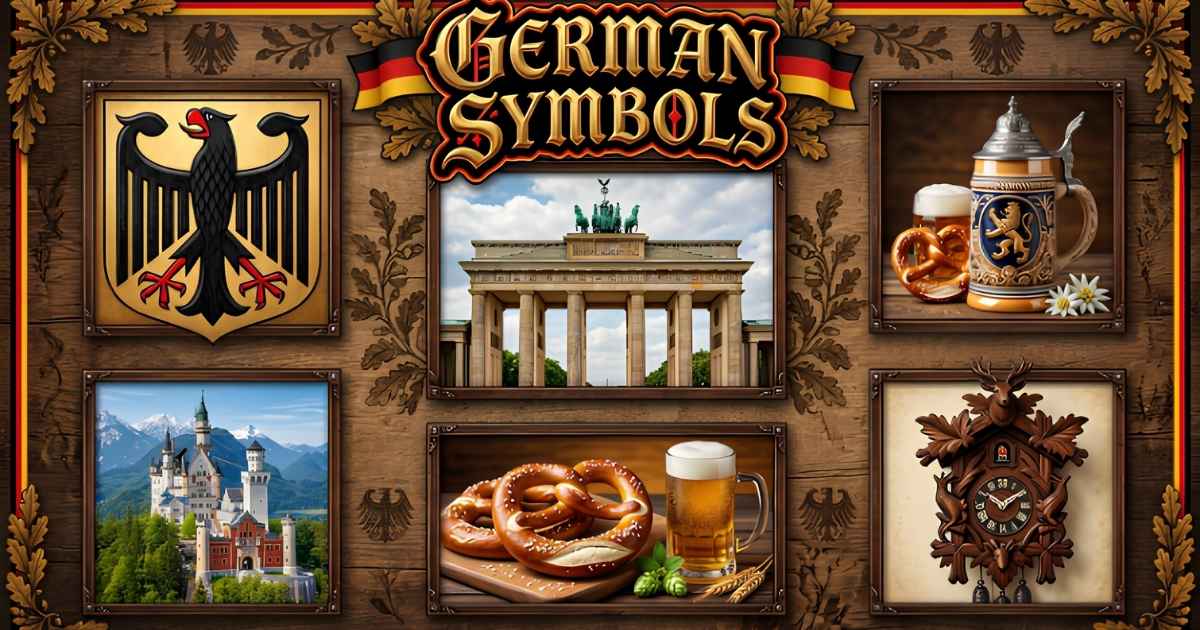

Germany is not just a country on the map. It is a civilization built on layers of meaning, power, and resilience. From ancient tribal carvings to the modern Federal Eagle printed on passports, German symbols tell a story that no history book can fully capture on its own.
These symbols have traveled through centuries of war, empire, division, and rebirth. They have been worn on soldier uniforms, carved into stone, tattooed on skin, and painted on castles. In 2026, they continue to shape identity, art, politics, and even tattoo culture worldwide.
If you have ever wondered why certain German emblems feel so powerful, this guide gives you the full picture.
What Are German Symbols?
German symbols are visual emblems, marks, and cultural icons that represent Germany’s identity, heritage, and values across different historical periods. They range from national emblems like the Federal Eagle and the black-red-gold flag to ancient Germanic runes, tribal markings, medieval heraldry, and folk traditions.
Germany was not always a unified country. Before unification in 1871, it was a patchwork of kingdoms, city-states, and duchies, each carrying its own symbols. This rich fragmentation is precisely why German symbolism is so layered and diverse. Every emblem carries multiple meanings depending on time, region, and context.
Ancient German Symbols And Their Hidden Stories
Ancient German Symbols
Ancient German symbols appeared thousands of years before the modern nation of Germany existed. These were carved into rock, stamped onto weapons, and worn as amulets. Common ancient symbols included the sun wheel, protective bind runes, and animal totems representing deities from the Germanic pantheon.
Many of these symbols were deeply spiritual. They were not decorative. They were believed to carry actual power, ward off evil, and connect warriors to the divine forces of nature and war.
Germanic Tribe Symbols

Germanic tribes used distinct symbols to identify their clans during battles and ceremonies. Each tribe developed its own set of visual marks tied to loyalty, protection, and unity. Symbols representing wolves, eagles, boars, and serpents were common. These animals were not just images but sacred representations of tribal gods and ancestral values.
Tribes like the Visigoths, Vandals, Franks, and Saxons each carried symbolic traditions that influenced later medieval heraldry across Europe.
Germanic Symbols
Germanic symbols as a broader category include runes, solar crosses, the Valknut (three interlocked triangles linked to Odin), and the Helm of Awe (a radial protective symbol). These are rooted in old Norse and Proto-Germanic traditions and were shared across the wider northern European world.
These symbols have seen a massive modern revival, appearing in historical research, tattoo art, video games, and cultural identity movements worldwide.
Read More: 25+ Hidden Symbols of Rebirth You See Every Day but Never Notice
German Symbols And Meanings In Modern Culture
German Symbols And Meanings
In modern culture, German symbols carry both official and personal meanings. The Federal Eagle stands for democracy and national unity. The Iron Cross represents military honor. Runes, when used responsibly, symbolize ancient wisdom, strength, and connection to pre-Christian Germanic culture.
Key meanings associated with German symbols:
- Eagle: Power, freedom, sovereignty
- Black-red-gold colors: Democracy, unity, national pride
- Iron Cross: Courage, military service, sacrifice
- Oak leaves: Heroism, endurance, deep German roots
- Cornflower: National identity, loyalty, remembrance
German Symbolism
German symbolism blends mythology, Christian heritage, medieval chivalry, and Enlightenment ideals. Unlike many national symbol systems, Germany’s has been repeatedly tested, destroyed, and reborn across different political eras. That cycle of transformation is itself part of what these symbols communicate.
Symbols Of Germany
The official national symbols of Germany include:
- The Federal Eagle (Bundesadler)
- The black-red-gold flag (Bundesflagge)
- The Brandenburg Gate
- The national anthem (Deutschlandlied, third stanza)
- The German coat of arms
Cultural symbols include Oktoberfest, the cuckoo clock, the cornflower, and Neuschwanstein Castle.
What Is The Symbol Of Germany?
The primary symbol of Germany is the Federal Eagle, or Bundesadler. It appears on the national coat of arms, coins, passports, and official government seals. The black eagle on a golden field is considered one of the oldest national symbols still in active use anywhere in the world.
German Symbols Text
German symbols in text form include runic characters from the Elder Futhark and Younger Futhark alphabets, Gothic script letters (Fraktur), and decorative typographic elements rooted in medieval manuscripts. These are widely used today in social media bios, tattoo scripts, and artistic branding.
German Symbols Letters
Old German letters draw from runic alphabets and the famous Fraktur blackletter typeface. Fraktur was the dominant printing style in German-speaking countries from the 16th century until the mid-20th century. Modern designers still use these styles for vintage branding, heavy metal album art, and cultural projects.
German Symbols To Copy
Popular Germanic symbols used in digital content and personal expression include:
- ᚠ (Fehu rune, wealth and prosperity)
- ᚢ (Uruz rune, strength and vitality)
- ᛏ (Tiwaz rune, justice and warrior spirit)
- ᛉ (Algiz rune, protection)
- ✠ (Iron Cross)
- ⚜ (Heraldic fleur-de-lis, used in some German regional coats of arms)
German Symbols Tattoos

German symbol tattoos are extremely popular globally. The most chosen designs include Elder Futhark runes for personal meanings, the Iron Cross for strength and resilience, the eagle for freedom and power, and Germanic knotwork for heritage connection. Tattoo artists recommend researching historical context carefully before choosing any symbol with politically sensitive associations.
Iconic, Ancient And Historical German Symbols
Iconic German Symbols
The most iconic German symbols recognized worldwide are the Federal Eagle, the Brandenburg Gate, and the black-red-gold flag. These three appear at every major national event, sports competition, and official government communication.
Traditional German Symbols
Traditional German symbols include the oak tree (representing endurance), the cornflower (national flower), the linden tree (symbol of justice and love), and regional coats of arms featuring lions, bears, and eagles.
Famous German Symbols
Famous German symbols beyond the official set include:
- Neuschwanstein Castle (Bavarian romanticism)
- The Berlin Bear (symbol of Berlin)
- The Bavarian blue-and-white diamond pattern (Rauten)
- Meissen porcelain crossed swords logo
Ancient German Symbols Tattoos
Ancient Germanic tattoo designs focus on runic inscriptions, the Vegvisir (a Norse-Germanic compass symbol), the Valknut, and tribal knotwork. These tattoos appeal to people interested in pre-Christian Germanic spirituality, Norse mythology, and ancestral heritage art.
Old German Symbols
Old German symbols from the pre-Christian era often combined nature worship with warrior traditions. The boar, sacred to the god Freyr, the raven connected to Odin, and the serpent linked to the World Tree (Yggdrasil) were all central to early Germanic symbolic language.
Meaningful German Symbols
The most personally meaningful German symbols tend to be those connected to family, loyalty, courage, and transformation. Runes like Raidho (journey), Mannaz (humanity), and Sowilo (sun, victory) carry deep personal resonance for those who study Germanic tradition.
Explore More: 85+ Powerful Life Symbols and Their Deep Meanings That Will Change Your Perspective
German Symbols In War, Politics and Family
WW1 German Symbols
During World War One, key German military symbols included the Iron Cross (awarded in multiple grades for battlefield bravery), the Imperial Eagle of the German Empire, and the black-white-red tricolor flag. The Pickelhaube helmet became an iconic visual symbol of the German soldier of that era.
WW2 German Symbols
World War Two German symbols are among the most studied and contested in history. The Nazi regime appropriated ancient Germanic symbols and warped their meanings for political propaganda. The swastika, originally an ancient symbol of good fortune found across many cultures, was formally adopted by the Nazi Party in 1920 and became their principal emblem.
WWII German Symbols
WWII-era symbols also included the SS double Sig rune insignia, the Totenkopf (death’s head), and the Nazi Party eagle (Parteiadler). Many of these symbols are now banned in Germany. Understanding them is essential for historical literacy, not glorification.
East German Symbols
East Germany (the German Democratic Republic, 1949-1990) used a distinct set of symbols reflecting its communist identity. The DDR flag featured a hammer, compass, and wreath of grain on the black-red-gold base. The East German state emphasized socialist solidarity over historical German nationalism.
German Symbols For Family

German symbols associated with family include the Othala rune (in its original, pre-Nazi meaning of inherited home and ancestral land), the linden tree (love and togetherness), the family coat of arms tradition (Familienwappen), and the oak tree representing generational strength.
Popular German Symbols
The most searched and recognized German symbols globally in 2026 remain:
- The Federal Eagle
- The Iron Cross
- The black-red-gold flag
- The Brandenburg Gate
- Elder Futhark runes
Deep Symbolic Meaning of German Symbols
Spiritual Meaning
Spiritually, Germanic symbols were gateways to divine forces. Runes were believed to be gifts from Odin, who, according to myth, hung himself on the World Tree for nine days to receive their wisdom. Each rune was considered both a letter and a spiritual force. The sun wheel symbolized cosmic cycles and divine light. The eagle represented the highest deity and the life force.
In modern spiritual practice, many people use Germanic runes for meditation, divination, and personal guidance, treating them as tools for self-reflection rather than religious doctrine.
Psychological Meaning
Psychologically, German symbols tap into deep archetypes. The eagle represents ambition and far-sightedness. The cross suggests sacrifice and transformation. National symbols create what psychologists call “collective memory anchors,” helping communities maintain shared identity across generations.
Carl Jung, a Swiss psychologist deeply influenced by German cultural heritage, identified many Germanic symbols as universal archetypes present in the human unconscious, connecting personal psychology to ancient mythological patterns.
Cultural Meaning
Culturally, German symbols communicate continuity through disruption. Germany has faced unification, war, division, and reunification, yet its core symbols have survived each transition, adapted, and re-emerged with renewed purpose. This cycle of symbolic resilience reflects the broader German cultural value of Aufarbeitung: the serious reckoning with history to move forward responsibly.
Types / Variations of German Symbols
1. Federal Eagle (Bundesadler)
The Bundesadler is Germany’s official state emblem. A black eagle with red feet, red tongue, and red beak on a golden field, it traces its origin to the Holy Roman Empire and was officially adopted in its modern form in 1950. It appears on all German coins, the national coat of arms, official seals, and federal buildings.
2. Black-Red-Gold Flag
Germany’s national flag features three equal horizontal stripes: black on top, red in the middle, gold at the bottom. Adopted in its current form in 1949, it symbolizes democracy, unity, and freedom. The colors link back to the 1848 revolutions and the liberal democratic movement against authoritarian rule.
3. Iron Cross (Eisernes Kreuz)
Originally created in 1813 during the Napoleonic Wars, the Iron Cross was a Prussian military decoration for bravery. Reintroduced in both World Wars, it carries a complex legacy. Since 1956, a modified version has served as the official symbol of the German Armed Forces (Bundeswehr), stripped of its more controversial associations.
4. Germanic Runes
The Elder Futhark, used from roughly 150 CE to 800 CE, is the oldest runic alphabet system. It contains 24 runes, each with a name, sound, and symbolic meaning. Runes were used for writing, magical inscriptions, divination, and commemoration. Modern interest in runes spans academic runology, Norse paganism, and tattoo culture.
5. Holy Roman Empire Eagle
The double-headed eagle of the Holy Roman Empire (962-1806) was a distinct variation of the Germanic eagle symbol. Two heads facing opposite directions represented the empire’s dual authority over spiritual and secular matters. This image influenced heraldry across Austria, Russia, Serbia, and Albania.
German Symbols Across Cultures
Ancient Germanic Tribes
Before Rome and Christianity reshaped northern Europe, Germanic tribes used symbols tied to nature worship, ancestor veneration, and warrior ethos. These early emblems laid the foundation for every later iteration of German symbolic identity.
Roman Influence
Roman legions carried eagle standards called aquilae into Germanic territory, creating a cultural dialogue that merged Roman imperial symbolism with existing Germanic eagle veneration. This cross-cultural exchange directly influenced the later use of the eagle as the primary German national emblem.
Medieval Europe
During the medieval period, German heraldry became one of the most elaborate symbolic systems in Europe. The Holy Roman Emperor’s eagle spread Germanic visual culture from Italy to Poland. Castles, cathedral windows, and knights’ shields carried a rich vocabulary of German symbolic language across the continent.
Modern Europe
Post-World War Two Germany deliberately reconstructed its symbolic identity around democratic values. The choice to retain the eagle but redesign it as a more open, stylized form represented a conscious cultural statement: strength without aggression, authority without domination.
Global Influence
Germanic runes appear in logos, tattoos, video games, and fantasy literature worldwide. The Bauhaus design movement, born in Germany in 1919, transformed global architecture, typography, and visual communication. German symbolic aesthetics, characterized by clean geometry and deep meaning, continue to shape global design in 2026.
German Symbols in Art, Movies & Pop Culture
German symbols appear constantly in global pop culture, often carrying layered meanings that audiences may not immediately recognize. Viking and Norse mythology films draw heavily on Germanic runic traditions. Video game franchises like “Assassin’s Creed” and “God of War” incorporate Elder Futhark runes directly into their visual language.
Bauhaus aesthetics influence everything from Apple product design to contemporary architecture. The Brandenburg Gate appears in films, political speeches, and music videos as a universal shorthand for resilience and reunification. Heavy metal music, especially the thrash and black metal genres, adopted Germanic runic imagery as part of their visual identity.
German Expressionist cinema (1920s-1930s), with films like “The Cabinet of Dr. Caligari” and “Nosferatu,” created a visual symbolic language of shadow and distortion that continues to influence horror and psychological thriller filmmaking globally.
Spiritual & Dream Meaning of German Symbols
When German symbols appear in dreams, practitioners of Jungian analysis and symbolic psychology often interpret them as follows:
- Eagle: A signal of rising ambition, desire for freedom, or a call toward leadership
- Iron Cross or cross shapes: Themes of moral sacrifice, internal conflict, or personal transformation
- Runes: Hidden wisdom surfacing, guidance from the unconscious, or ancestral memory
- National flag colors (black, red, gold): Emotional tension moving toward resolution and clarity
In broader spiritual frameworks, Germanic symbols are often associated with archetypes of the warrior, the sage, and the sovereign, three figures that appear across psychological, mythological, and spiritual traditions worldwide.
Positive vs Negative Meaning
Positive Meanings
- The eagle represents sovereignty, vision, and national pride with deep democratic roots
- The black-red-gold flag stands for unity, freedom, and the hard-won lessons of history
- Germanic runes, in their original context, carry wisdom, protection, and personal guidance
- The Iron Cross, in its modern Bundeswehr form, represents courage and military service without political extremism
- The linden tree and cornflower connect to love, loyalty, and peaceful national identity
Negative Interpretations
- Several WWII-era symbols, including the swastika and SS runes, are banned in Germany and carry deeply harmful historical associations
- Runes have been misappropriated by far-right extremist groups, stripping them of their authentic historical meaning
- The Iron Cross, when displayed in certain contexts, can be misread as an endorsement of militarism or nationalism
- Context, intent, and historical awareness matter enormously when engaging with any German symbol
Why Humans Are Attracted to German Symbols
The human brain is wired for pattern recognition, symmetry, and meaning, and Germanic symbols deliver all three in concentrated form. Runes are geometrically elegant. The eagle is visually commanding. The Iron Cross is structurally balanced. These are not accidents. They are the result of centuries of visual refinement.
Beyond aesthetics, German symbols carry stories of survival. Germany has been rebuilt from rubble twice in the 20th century alone. People worldwide are drawn to symbols that represent transformation, resilience, and the ability to rise from destruction. That emotional resonance crosses cultural and linguistic boundaries.
There is also the appeal of depth. Each German symbol contains multiple historical layers that reward deeper exploration. Unlike purely decorative imagery, Germanic symbols invite research, conversation, and personal meaning-making, qualities that make them enduringly compelling in an age of surface-level visual culture.
Conclusion
German symbols are far more than national decorations. They are compressed histories, spiritual tools, cultural arguments, and living evidence of a civilization that has repeatedly transformed itself without losing its core identity.
From the ancient runic carvings of the first Germanic tribes to the Federal Eagle stamped on a modern German euro coin, these symbols have traveled an extraordinary distance. They have been misused, contested, banned, reclaimed, and reimagined.
In 2026, understanding German symbols means understanding one of history’s most complex and consequential civilizations. Whether you are drawn to them for their aesthetic power, spiritual depth, historical significance, or personal meaning, they reward serious attention and thoughtful engagement.
