
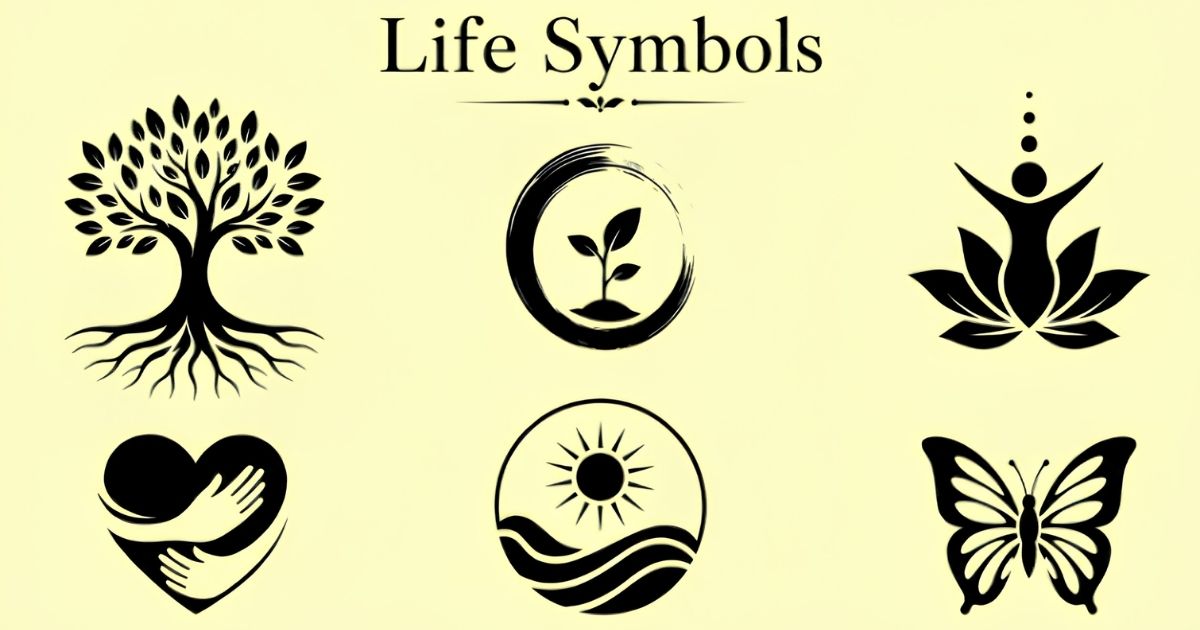

Life symbols are visual representations that humans have used for thousands of years to express the deepest truths about existence, growth, and transformation. From ancient cave paintings to modern tattoos, these sacred symbols speak a language that goes far beyond words. They connect your personal story to something timeless and universal. Whether you’ve spotted a lotus flower on a yoga mat or an infinity sign on someone’s wrist, you’ve already encountered life symbolism in action.
What Are Life Symbols?
Life symbols are shapes, signs, or images that represent the core experiences of being alive: birth, growth, change, and renewal. Ancient civilizations carved them into stone long before written language existed because they needed a way to communicate ideas that words couldn’t fully capture.
These symbols appear across every major culture on earth. That’s not a coincidence. It points to something deeply human: our shared need to find meaning in existence. The symbolic meaning of life has been explored through Egyptian hieroglyphs, Celtic knotwork, Buddhist mandalas, and Greek mythology, all drawing from the same well of universal human experience.
Today, life symbols still carry enormous emotional and spiritual weight. You’ll find them in jewelry, tattoos, religious art, logos, and home decor. Understanding them gives you a richer lens for reading the world around you.
Life Symbols and Meanings
Different cultures assign different meanings to life symbols, but certain themes keep showing up everywhere: growth, transformation, eternity, and rebirth. These aren’t random. They reflect the stages every human being moves through.
Here’s a quick overview of the most widely recognized life symbols and what they stand for:
| Symbol | Origin | Core Meaning |
| Tree of Life | Universal | Growth, connection, family |
| Ankh | Ancient Egypt | Eternal life, immortality |
| Lotus Flower | Buddhism/Hinduism | Rebirth, purity, awakening |
| Phoenix | Greek/Egyptian | Transformation, rising again |
| Infinity Symbol | Modern/Mathematics | Endless possibility, eternal love |
| Spiral | Celtic/Nature | Personal growth, life’s journey |
| Circle | Universal | Unity, wholeness, eternity |
Each of these symbols carries layers of meaning that have deepened over centuries. They’re not just pretty designs. They’re maps of the human experience.
Explore More: 25+ Hidden Symbols of Rebirth You See Every Day but Never Notice
Tree of Life Symbols

The Tree of Life is arguably the most recognized life symbol across the entire world. It appears in Norse mythology as Yggdrasil, in the Hebrew Kabbalah as the Etz Chaim, in Celtic traditions as the Crann Bethadh, and in ancient Egyptian and Assyrian art. Every culture seemed to independently arrive at the same image: a great tree connecting earth and sky.
What makes this symbol so powerful is its structure. The roots anchor deep into the ground, drawing strength from what’s invisible. The trunk stands firm through every season. The branches reach outward and upward toward light and possibility. That three-part structure mirrors human life beautifully.
In modern America, the Tree of Life appears everywhere from wall art to family crest jewelry. People choose it to represent their family roots, personal resilience, and the belief that life continues through generations.
Tree of Life Symbols and Meanings
The deeper meanings of the Tree of Life break down like this. The roots represent your ancestors, your foundation, and the invisible support systems that keep you grounded. They remind you that who you are today was shaped long before you were born.
The trunk symbolizes stability and strength, the ability to stand firm even when storms come. Many people going through hard times connect with this part of the symbol most deeply, because it reflects the unshakeable core within them.
The branches point toward growth, wisdom, and future generations. They show how one life spreads outward and touches others. In family symbolism, the branches represent children, community, and the legacy you leave behind.
Eternal Life Symbols
Symbols of immortality and eternal life have fascinated humans since the beginning of recorded history. Ancient Egyptians built entire belief systems around them. Early Christians adopted many of the same images. Eastern traditions approached eternity through the lens of reincarnation and spiritual cycles.
The most powerful eternal life symbols include the Ankh, the Ouroboros (a snake eating its own tail), the unbroken circle, and the infinity sign. Each one visually communicates the same idea: life doesn’t end, it transforms.
What’s interesting is that these symbols aren’t only about what happens after death. They also speak to the eternal nature of love, memory, and meaning. A person who wears an infinity symbol on their ring finger isn’t necessarily making a theological statement. They’re expressing a feeling: that what they share with someone will outlast time itself.
Symbols of Life

The most universal symbols of life come from nature because nature is where life is most visible. The sun rises every morning without fail. Water flows and sustains everything that grows. Trees breathe and cycle through seasons. Seeds split open and push through dirt toward light.
These natural life symbols resonate across every cultural background because they don’t require any translation. Whether you grew up in rural Montana or downtown Chicago, you understand what a sunrise means. You know what it feels like to watch something grow from a seed.
In spiritual and religious traditions, these natural symbols get elevated into sacred imagery. The sun becomes a god. Water becomes a purification ritual. A tree becomes the axis of the entire cosmos.
What Symbolizes Life
If someone asks you what symbolizes life, the honest answer is: almost everything that moves, grows, or shines. But some symbols carry that meaning more directly than others.
The sun is one of the oldest and most universal life symbols on earth. Without it, nothing lives. Ancient Egyptians worshipped Ra, the sun god. The Aztecs built pyramids aligned to solar cycles. Even today, “sunshine” is a term of endearment and warmth.
Water symbolizes life because it’s the literal building block of every living organism. Rivers, rain, and oceans appear in creation myths from every corner of the world. A flowing river is also a symbol of life’s constant movement: you can’t step into the same river twice.
The heartbeat line, that simple EKG wave on medical monitors, has become a powerful modern life symbol. You’ll see it in tattoos, memorial designs, and fitness branding. It says, simply and directly: I am alive.
Symbol of Life
When people search for a single “symbol of life,” the Tree of Life usually comes out on top. It’s the most cross-cultural, most immediately recognizable, and most emotionally layered of all life symbols.
But the Ankh deserves equal mention. This ancient Egyptian cross with a loop at the top is one of the earliest written symbols for life in recorded history, predating most modern alphabets. Pharaohs carried it. Gods were depicted holding it. It meant eternal life in its purest form.
The choice of your personal symbol of life often reflects what aspect of living matters most to you: growth, endurance, connection, or eternity.
Life Symbols and Meanings
Butterfly symbolism is deeply tied to personal transformation symbols and new life. A butterfly spends part of its existence as a caterpillar, then enters a period of darkness and changes inside a chrysalis, and emerges completely transformed. That’s not just a metaphor. It’s a biological fact that humans have recognized for centuries as one of nature’s most vivid lessons about change.
The lotus flower carries a similar message but through a different lens. It grows in muddy, murky water and rises to bloom in clean air above the surface. In Buddhism and Hinduism, this represents the soul’s journey through suffering toward spiritual awakening. In modern American wellness culture, the lotus has become a symbol of resilience: the idea that beauty can come from struggle.
Both the butterfly and the lotus remind you that transformation isn’t comfortable. It’s messy. But what comes out the other side is worth it.
Symbols for Life
In American culture, symbols for life show up in personal and public spaces constantly. Think about the green cross used by hospitals and pharmacies. The olive branch on the U.S. Presidential Seal. The eagle in flight. The flame of the Statue of Liberty’s torch. These aren’t accidental choices.
People also choose personal life symbols to carry with them as daily reminders of what matters. A mother might wear a Tree of Life necklace to represent her children. A cancer survivor might tattoo a phoenix on their arm. A couple might exchange infinity rings on their wedding day.
The power of these symbols of hope and strength lies in their ability to hold meaning without requiring explanation. You don’t need to describe your whole story when the symbol on your wrist already tells it.
Symbol for Change in Life

The butterfly is the strongest symbol for change in life, and it earns that status through its biology. The transformation from caterpillar to butterfly isn’t gradual. It’s radical. Inside the chrysalis, the caterpillar’s body actually dissolves before rebuilding into something entirely new. Scientists call this process histolysis. It’s a complete breakdown before a complete rebuild.
That makes the butterfly more than a pretty metaphor. It’s an accurate representation of how real change often works: things have to fall apart before they can come together in a new form.
The phoenix carries a similar message on a more dramatic scale. This mythological bird from Greek and Egyptian tradition burns completely to ash before rising again, more powerful than before. People who’ve survived addiction, trauma, loss, or failure often identify deeply with the phoenix. It says: I burned down, and I came back.
Symbols That Have Deep Meaning
Some symbols carry so much weight that a single glance can stop you in your tracks. The infinity symbol is one of them. What looks like a simple sideways figure eight carries the weight of eternity, limitless love, and the idea that some things never truly end.
The circle is another. It’s the oldest symbol on earth, appearing in prehistoric cave art and sacred geometry alike. The circle has no beginning and no end. In every culture that used it, the circle represented completeness, unity, and the eternal cycle of life and death. The wedding ring is a circle. The wheel is a circle. The sun is a circle. Sacred mandalas are built from circles. This one shape holds an extraordinary amount of symbolic meaning.
Psychologists note that humans are drawn to circular shapes because they signal safety, wholeness, and continuity. These aren’t just cultural preferences. They may be built into how our brains process visual information.
Things That Represent Life
Nature offers the most honest representations of life because life itself is a natural process. A seed might be the most quietly powerful life symbol that exists. It contains everything needed for a full-grown plant, tree, or flower, all compressed into a tiny shell, waiting for the right conditions to unfold.
A candle flame represents life’s delicate, luminous nature. It gives light and warmth, but it can be extinguished. It flickers in wind. It transforms solid wax into heat and glow, which is itself a kind of alchemy.
Fire in general has symbolized life across almost every ancient culture. The Greek god Prometheus stole fire from the gods to give to humanity. Fire ceremonies appear in Native American, Hindu, and Celtic traditions. The Olympic torch, still carried today, is a direct descendant of ancient fire symbolism.
What Represents Life
Life is most powerfully represented by things that move, grow, or give light. Movement means life. Stillness, in its extreme form, is the opposite.
A flowing river represents life because it never stops moving. A growing plant represents life because it reaches toward something. A heartbeat represents life because its rhythm is the most basic proof of existence. The sun represents life because everything on Earth depends on its energy.
In modern culture, the heartbeat line has taken on particular significance. It appears in medical contexts, memorial tattoos, fitness apps, and motivational designs. It’s simple, universal, and unmistakable in its meaning: this is what it looks like to be alive.
Things That Symbolize Life
Trees are among the most beloved nature symbols of life because they live so much longer than humans do. A 500-year-old oak tree has witnessed generations of human lives come and go. It breathes, grows, and regenerates. It shelters wildlife and produces oxygen. For many people, a tree represents everything they hope their own life will be: rooted, resilient, generous, and long-lasting.
Flowers symbolize life in a more fragile, transient way. They bloom brilliantly and briefly. In Japanese culture, this idea is captured in the concept of “mono not aware,” the bittersweet awareness that beautiful things don’t last forever. Cherry blossoms are celebrated precisely because they fall so quickly after blooming. That fragility is part of what makes them meaningful as life symbols.
Birds, especially in flight, represent freedom and the full expression of a living being moving through the world without restriction.
Symbol of Life Meaning

The meaning behind any life symbol operates on three levels simultaneously. On the physical level, it represents the biological fact of being alive: breath, heartbeat, growth, and survival. On the emotional level, it represents the inner life: love, hope, grief, and resilience. On the spiritual level, it represents the soul’s journey through existence and beyond.
This layered quality is what gives life symbols their staying power. A lotus flower tattoo might mean different things to three different people who all chose the same image. For one, it’s about surviving a difficult period. For another, it’s a spiritual commitment. For a third, it’s simply beautiful. All three meanings are valid, and none cancels out the others.
That flexibility is actually a feature of great symbols. They hold meaning loosely enough to fit individual experience while pointing toward something universal.
Symbol for Life
The symbols most consistently chosen to represent life across cultures tend to share one quality: they suggest continuity. The Tree of Life keeps growing. The circle never ends. The spiral keeps turning. The phoenix keeps rising.
This isn’t accidental. Humans need to believe that life continues, that effort accumulates, that love persists, that who we are matters beyond the moment. Life symbols give that belief a visual anchor. They make the invisible visible.
The spiral deserves special mention here. It appears in nature in shells, galaxies, ferns, and fingerprints. It appears in Celtic art, Maori tattoos, and Neolithic carvings that are thousands of years old. The spiral suggests that life doesn’t move in a straight line. It curves, loops back, and expands outward. That’s an honest description of how growth actually works.
Symbols That Represent Life
Sun, water, lotus, phoenix, and fire each represent life from a different angle. The sun represents energy and sustenance. Water represents flow and purity. The lotus represents beauty emerging from struggle. The phoenix represents renewal after destruction. Fire represents passion and the transformative power of heat.
Together, they form a complete picture of what life actually involves: warmth and coolness, stillness and movement, destruction and creation. No single symbol captures all of it. That’s why cultures developed entire systems of symbols rather than relying on just one.
What Symbol Represents Life
The most direct answer to this question depends on your cultural background and personal experience. Universally, the Tree of Life is the most widely recognized single symbol of life. Across ancient Egypt, Norse mythology, Celtic tradition, Buddhism, Judaism, and Christianity, some version of this symbol appears.
For ancient Egyptians specifically, the Ankh was the definitive answer. It was used in hieroglyphic writing, carried by gods, and placed in tombs to guide souls into eternal life.
In modern Western culture, the heartbeat line has emerged as a contemporary answer. It requires no cultural knowledge to understand. It says, instantly and clearly: alive.
Powerful Symbols with Deep Meanings
The phoenix carries what may be the most emotionally resonant meaning of any life symbol. The story is simple: a magnificent bird burns completely to ash, and from those ashes, a new bird is born. Ancient Greeks used it to represent the immortality of the soul. In modern times, it’s become the symbol of choice for people who’ve survived something that should have broken them.
The lotus is equally powerful but quieter in its message. It doesn’t announce its strength. It simply rises. Every morning, the lotus closes and sinks below the water’s surface. Every morning, it rises again and blooms. That daily cycle of descent and return has made it a symbol of both resilience and spiritual renewal and rebirth across Asian and Western traditions alike.
The Tree of Life, as we’ve noted, synthesizes both messages. It roots in the dark earth and reaches toward the light. It lives through seasons of bare branches and seasons of full bloom. It’s a symbol that contains the full arc of a life, including the parts that aren’t beautiful.
Symbol That Represents Life

A green leaf is perhaps the simplest and most immediate life symbol available. You don’t need to know anything about mythology or religion to understand what a green leaf means. It’s alive. It’s growing. It’s converting sunlight into energy. That’s life in its most basic, visible form.
Flowing water carries that message forward into something more complex. Water doesn’t just exist. It moves, shapes its environment, and adapts to every obstacle it meets. It finds a way through or around whatever blocks its path. As a life symbol, water suggests that living is an active, adaptive process, not a static state.
The circle brings it all home. Simple, unbroken, eternal. No beginning. No end. Just continuous existence.
Symbols Representing Life
Across art, religion, and nature, the symbols that represent life most consistently are the ones that suggest ongoing movement. A spiral keeps turning. A tree keeps growing. A bird keeps flying. A river keeps flowing.
What these symbols share is the quality of process. Life isn’t a destination or a fixed state. It’s a continuous unfolding. The best life symbols capture that sense of perpetual motion and growth.
In American culture, this resonates particularly well. The national narrative has always been built around growth, possibility, and forward movement. It’s no accident that life symbols have found such a warm home in American tattoo culture, spiritual communities, and popular design.
Objects That Represent Life
Some of the most powerful life symbols aren’t grand mythological images. They’re ordinary objects that carry extraordinary weight.
A seed holds an entire future inside a shell smaller than your thumbnail. A candle burns its own substance to give others light. A heartbeat monitor transforms the invisible electrical activity of a living heart into a visible wave. A clock marks the passage of the one resource that life consumes and can never recover: time.
These objects represent life not through mythology or religious tradition, but through direct, physical reality. They’re grounded in experience, which is part of why they resonate so broadly across different backgrounds and belief systems.
Symbols Meaning Life
At their core, symbols that mean life are about continuation. The circle doesn’t stop. The Ankh opens at the top, suggesting ascension and continuation beyond the physical. The Tree of Life roots downward and extends upward simultaneously, connecting what was with what will be.
The butterfly adds a crucial nuance: continuation doesn’t mean sameness. The butterfly that emerges from the chrysalis is not the same creature that entered. It’s transformed. That distinction matters, because it suggests that life’s continuation involves constant change and growth, not just persistence.
This is why these symbols endure. They don’t promise an easy path. They promise that the path continues.
Symbolism for Life
The broadest theme in life symbolism is the tension between light and darkness, growth and decay, birth and death. Great life symbols don’t shy away from that tension. They hold both sides.
The lotus grows in mud. The phoenix rises from ash. The Tree of Life has roots in darkness and branches in light. The circle encompasses both the empty space inside and the line that bounds it. These symbols are honest about the full complexity of being alive, and that honesty is what makes them meaningful rather than merely decorative.
When you choose a life symbol, you’re not choosing a fantasy. You’re choosing a true representation of the journey.
What Symbolises Life
Nature answers this question most directly. Trees live, breathe, and grow for centuries. Water flows through every living system on earth. Fire transforms matter into energy. Seeds contain entire futures. Flowers bloom, fade, and return.
The heartbeat is the most personal and immediate life symbol of all. It’s unique to you, measurable, and undeniable. When it stops, life stops. When it’s strong and steady, so are you.
Symbolism of Life
The deepest symbolism of life circles around one idea: cycles. Day and night. Summer and winter. Birth and death. Waking and sleeping. Breathing in and breathing out.
Life isn’t linear. It doesn’t move from point A to point B in a straight line. It spirals, loops, rises, falls, and rises again. The most accurate life symbols are the ones that reflect this cyclical truth, the circle, the spiral, the tree that loses its leaves every fall and regrows them every spring.
Understanding this changes how you experience your own life. The hard seasons aren’t the end of the story. They’re part of the cycle.
Thing That Represent Life
A growing plant on a windowsill. A newborn baby’s first breath. A river carving its way through rock over centuries. A fire burning through a cold night. These aren’t poetic abstractions. They’re real things that represent life in its most immediate, tangible form.
What they share is agency. They don’t wait for permission to grow, move, burn, or begin. They simply do what life does. And in doing so, they remind us to do the same.
Greek Life Symbols
Ancient Greek culture gave the world some of the most enduring mythological symbols tied to life, wisdom, and renewal. The Greeks understood that life was inseparable from struggle, transformation, and the pursuit of wisdom. Their symbols reflect that understanding with remarkable depth.
Greek life symbols have remained culturally relevant for over two thousand years. You’ll find them in American architecture, academic seals, government buildings, and personal jewelry. They’ve proven remarkably durable because the ideas they represent are genuinely universal.
The Greeks were also unusually honest about the complexity of life. Their myths didn’t sanitize suffering. They showed life, including its pain, as the necessary context for wisdom and growth.
Flower of Life Symbols
The Flower of Life is a sacred geometry symbol made of overlapping circles arranged in a perfect floral pattern. It’s been found carved into the Temple of Osiris in Egypt, ancient Chinese temples, and medieval European architecture. The fact that the same geometric form appeared across cultures with no known contact with each other has led many researchers to call it a true universal symbol.
The Flower of Life is believed to contain the patterns underlying all of creation. Sacred geometry scholars see in it the building blocks of matter, space, and form. The Seed of Life, the Fruit of Life, and the Metatron’s Cube are all derived from the same overlapping circle pattern.
In modern American spiritual and wellness communities, the Flower of Life appears in meditation spaces, yoga studios, healing arts, and spiritual jewelry. It represents unity, harmony, and the interconnectedness of all living things.
Pro Life Symbols
In American culture, pro life symbols are used in advocacy, awareness campaigns, and public discourse around the protection of human life, particularly unborn life. These symbols are chosen deliberately for their emotional resonance and visual clarity.
The most widely recognized is the pink and blue baby feet logo, which depicts tiny footprints in the shape of a heart. It combines the imagery of new life with the shape of love, sending a clear message about the value of life at its earliest stage.
The butterfly is also used in this context as a symbol of new beginnings and the transformative potential of every life. The heart, as a universal symbol of care and compassion, appears frequently in this symbolism as well.
These symbols function across different age groups and backgrounds because they tap into emotions and instincts that most people share regardless of their political views.
Greek Life Symbols and Meanings
The Ankh-Style Cross (Sometimes Confused)
Many Americans confuse the Ankh with Greek symbols, but it’s important to clarify: the Ankh is Egyptian in origin. The confusion often arises because both Greek and Egyptian civilizations influenced each other heavily during the Hellenistic period. True Greek life symbols are distinct and equally fascinating.
The Greek Key (Meander)
The Greek Key, also called the Meander, is a repeating geometric pattern that represents infinity and the continuous flow of life. Named after the Meander River in modern-day Turkey, known for its winding course, this pattern was used extensively in Greek architecture, pottery, and textile design. You’ll still see it today on fashion borders, architectural trim, and home decor.
The Owl
In ancient Greece, the owl was the sacred companion of Athena, goddess of wisdom. As a life symbol, the owl represents wisdom, knowledge, and the ability to see clearly in darkness. American universities and academic institutions have adopted the owl as a symbol of learning and intellectual life, connecting directly back to this Greek tradition.
The Olive Branch
The olive branch was given to winners of the ancient Olympic Games and used as a symbol of peace between warring city-states. Its connection to the olive tree, which lives for thousands of years and produces fruit through all seasons, made it a natural symbol of enduring life. The olive branch appears in the Great Seal of the United States, carried in the right talon of the eagle, representing the nation’s desire for peace.
Spiritual Life Symbols and Meanings
Lotus Flower
The lotus is the defining spiritual awakening symbol of Eastern traditions. It blooms from muddy water into pristine beauty, representing the soul’s ability to rise above suffering, desire, and confusion toward clarity and enlightenment. In Buddhism, the lotus is associated with the Buddha himself. In Hinduism, the goddess Lakshmi sits upon a lotus, representing prosperity, purity, and spiritual grace.
Tree of Life
As a spiritual symbol, the Tree of Life represents the axis connecting heaven, earth, and the underworld across virtually every major world religion. In Jewish mysticism, the Kabbalistic Tree of Life maps the ten attributes through which God reveals himself to creation. In Christianity, the Tree of Life appears in both Genesis and Revelation, bookending the entire biblical narrative.
Infinity Symbol
The infinity symbol entered modern consciousness through mathematics in the 17th century, but its spiritual meaning runs much deeper. In spiritual traditions, ∞ represents not just endlessness but the idea that all things are connected in an unbroken loop of cause and effect, give and take, love and return.
Spiral
The spiral is one of the oldest symbols found in human art, appearing in Neolithic carvings in Ireland, on pottery from ancient China, and in the rock art of indigenous peoples across the Americas. Spiritually, the spiral represents the journey of personal growth: moving outward from a center, expanding with each turn, never quite returning to the exact same point but always cycling back toward the core.
New Life Symbols
Butterfly
The butterfly represents new life with a biological accuracy that no other symbol can match. The metamorphosis process is not gradual improvement. It’s complete dissolution and reconstruction. Scientists have found that when a caterpillar forms a chrysalis, its body breaks down almost entirely before reforming as a butterfly. That’s not change. That’s transformation at the most fundamental level. It’s why the butterfly resonates so deeply with people who’ve experienced radical personal change.
Sunrise
Every sunrise is a daily renewal. The sun doesn’t technically “rise,” of course. The earth rotates toward it. But what we experience is the return of light after darkness, warmth after cold, visibility after blindness. That experience is one of the most universal human encounters with the idea of new beginnings.
Egg
The egg as a life symbol predates recorded history. It appears in creation myths from ancient Egypt, India, China, Greece, and Polynesia. The cosmic egg, also called the World Egg, is the starting point of existence in many of these traditions. Even in modern American culture, the egg remains a potent symbol of new life, most visibly at Easter celebrations that blend Christian and pre-Christian spring symbolism.
Phoenix
The phoenix myth originated in ancient Egypt and was adopted by the Greeks, who made it one of their most powerful symbols of immortality. The bird lives for hundreds of years, then builds a nest of aromatic wood that catches fire from the heat of the sun. The bird burns completely, then rises from the ash, young and renewed. For anyone who has survived something that felt unsurvivable, the phoenix is more than a symbol. It’s a recognition.
Base 12 Eternal Life Symbols
The number 12 holds a unique position in human timekeeping and sacred numerology. There are 12 months in a year, 12 signs in the zodiac, 12 hours on a clock face, 12 disciples in Christian tradition, and 12 tribes of Israel. Sacred geometry traditions associate 12 with completeness and divine order.
Life symbols connected to base 12 include the 12-petaled lotus, which appears in chakra systems as the heart chakra symbol, the 12-pointed star, and the 12-spoked dharma wheel. These forms suggest that life and eternal existence operate according to patterns that are mathematical in their precision, not random.
Egyptian Life Symbols
Ancient Egyptians believed that physical death was not the end of life but a transition into a different form of existence. Their ancient symbols of life were designed to support and protect that transition, which is why they appear so frequently in tombs, burial chambers, and funerary art.
The Ankh
The Ankh is the most famous of all Egyptian life symbols. Its distinctive shape, a cross with a teardrop loop at the top, has been interpreted as representing the union of male and female principles, the sunrise over the horizon, and the key to eternal life. Gods were depicted holding the Ankh to the lips of pharaohs, granting them the breath of eternal life.
The Scarab Beetle
The scarab beetle, specifically the dung beetle, was observed by Egyptians rolling balls of dung across the ground, an act they associated with the sun god Khepri rolling the sun across the sky. The scarab became a powerful symbol of rebirth and renewal, as well as solar energy and the cycle of life. Scarab amulets were placed in tombs to protect and revive the deceased.
The Djed Pillar
Less well-known but equally significant, the Djed Pillar represents stability, endurance, and long life. Associated with the god Osiris, the Djed was raised as part of ritual ceremonies meant to ensure the stable continuation of life. It looks like a column with horizontal rings near the top and represents the spine of Osiris.
The Eye of Horus
The Eye of Horus is a symbol of protection, restoration, and healing. According to Egyptian mythology, Horus lost his eye in battle and had it magically restored. The eye then became a symbol of regeneration and wholeness. It’s important to distinguish this from the Eye of Ra, which represents the destructive and protective power of the sun god. Both appear in modern tattoo and jewelry culture, but they carry different meanings.
Life Symbols With Meaning
The most meaningful life symbols aren’t chosen randomly. They’re chosen because they mirror something real in your personal experience. A cancer survivor who chooses a phoenix tattoo isn’t following a trend. They’re finding a visual language for something they’ve lived through that ordinary words don’t fully capture.
This personal resonance is what elevates a symbol from decoration to meaning. The symbol becomes a reminder, a commitment, and a story compressed into a single image. It says something true about who you are and what you’ve survived.
Research in psychology suggests that symbolic thinking is one of humanity’s most fundamental cognitive capacities. We are meaning-making creatures. Life symbols are tools for that meaning-making process, giving form to experiences that would otherwise remain formless.
Life Symbols Casket Corners
Life symbols appear on casket corners as a form of spiritual comfort for grieving families. The most common designs include the cross (representing faith in resurrection and eternal life), the dove (representing peace and the soul’s ascent), and floral motifs like lilies and roses (representing the beauty and transience of life).
These aren’t merely decorative choices. They’re carefully selected to communicate the deceased’s beliefs and the family’s hopes for what comes after. They’re also a form of honor, a way of saying that this life mattered and continues to matter in some form beyond physical existence.
The tradition of marking burial objects with life symbols is as old as human civilization itself. Egyptian pharaohs were buried with Ankhs. Viking warriors were buried with symbols of Odin. Native American traditions placed meaningful objects and symbols with the dead. The impulse is universal.
Life Life Symbols and Meanings
The lotus, the circle, and water represent life from three distinct but complementary angles. The lotus shows that beauty and purity can emerge from difficult, murky conditions. The circle shows that life has no true ending, only transitions. Water shows that life is always moving, always adapting, always finding its way forward.
Understanding these symbols together gives you a more complete picture of what life actually involves. It’s not always beautiful. It’s not always clear or calm. But it keeps moving. It keeps rising. It keeps cycling back toward something that feels like beginning.
Everyday Life Symbols

You’re surrounded by life symbols every single day, even if you don’t think of them that way. A heart on a coffee mug is a descendant of thousands of years of love symbolism. A clock on the wall is a life symbol that marks the passage of the one resource you can never recover. A smiley face distills one of life’s most fundamental experiences, happiness, into a single curved line and two dots.
Even traffic lights operate on color symbolism with deep roots in life and nature symbolism. Green for go and growth. Red for stop and danger. These color associations weren’t invented by traffic engineers. They’re drawn from centuries of cultural meaning attached to those colors.
Real Life Symbols
Real-world natural phenomena make the most powerful life symbols because they’re already true before they’re symbolic. A mountain represents strength and challenge because mountains literally are strong and challenging. A river represents change and flow because rivers literally change and flow. A sunrise represents hope and new beginnings because the return of light after darkness literally is hopeful.
This grounding in reality is what gives natural life symbols their staying power. They don’t require belief in any particular religion or mythology. They work on a purely experiential level, connecting to emotions and truths that every human being shares simply by being alive on this planet.
Meaning of Life Symbols
The meaning you take from a life symbol is shaped by three things: cultural context, personal experience, and universal human truths. A butterfly means transformation in Buddhist tradition, in Native American spirituality, and in secular American tattoo culture. But what kind of transformation it represents depends on who’s wearing it and why.
This layering of meaning is actually a feature, not a bug. It means that life symbols are flexible enough to serve different people at different stages of life. The lotus you choose at 25 as a symbol of fresh beginnings might mean something entirely different to you at 45, when you’ve weathered more, grown more, and risen from more difficulty.
Real Life Symbols of Rebellion
The raised fist is one of the most recognizable symbols of rebellion and resistance in American history. It represents solidarity, defiance, and the refusal to accept conditions that diminish human dignity. First used in labor movements in the early 20th century, it was adopted by civil rights movements, women’s liberation movements, and more recently by Black Lives Matter.
Broken chains represent freedom from systems of control and oppression. This symbol appears in abolitionist art from the 18th century onward and continues to appear in activism and memorial art. As a life symbol, broken chains say that certain conditions are incompatible with full human life and that breaking free from them is an act of affirming life itself.
These symbols of rebellion are also, at their core, symbols of hope and strength. They express the belief that human dignity is worth fighting for and that life lived under oppression is a life incompletely lived.
Deep Symbolic Meaning of Life Symbols
Spiritual Meaning
On a spiritual level, life symbols point to the eternal nature of the soul and the idea that physical existence is one chapter of a longer story. The Tree of Life, for instance, connects the visible world to the invisible: roots in the underworld, trunk in the human realm, branches in the divine. This threefold structure mirrors the spiritual cosmology of dozens of traditions.
Spiritual life symbols also serve as anchors for prayer, meditation, and contemplation. When you focus on a symbol with intention, it functions like a doorway, guiding your attention toward the deeper truths it represents. Many meditation traditions use visual symbols called yantras or mandalas precisely because of this focusing power.
Psychological Meaning
Carl Jung identified what he called archetypes: universal patterns of meaning that appear across all cultures and time periods because they reflect deep structures of the human psyche. Life symbols are archetypal. The phoenix doesn’t mean rebirth because someone decided it should. It means rebirth because the image of rising from destruction resonates with something hardwired into human psychology.
This is why people in grief are often drawn to symbols of renewal. Why survivors choose symbols of strength. Why people in transition reach for symbols of transformation. These aren’t just decorative choices. They’re psychological tools for processing and integrating experience.
Cultural Meaning
Culturally, life symbols function as connective tissue between generations. When a Native American artist carves a spiral into stone, they’re connecting to thousands of years of meaning passed down through their community. When a Jewish family places a Tree of Life on their wall, they’re connecting to centuries of Kabbalistic tradition and family heritage.
This cultural dimension is why life symbols feel more than decorative. They carry the weight of communal memory. Wearing or displaying them is a way of saying: I belong to this story. I carry this forward.
Types and Variations of Life Symbols
1. The Tree of Life
Deep roots, strong trunk, wide-reaching branches. This symbol captures the full arc of life: what sustains us, what grounds us, and what we reach toward.
2. The Ankh
Ancient Egypt’s key to eternity. A cross with a loop, simple in form, profound in meaning: life continues beyond what the eye can see.
3. The Infinity Symbol
A figure eight on its side, suggesting that life, love, and meaning have no fixed endpoint. Popular in modern jewelry and tattoos for exactly this reason.
4. The Spiral
Nature’s own drawing, appearing in shells, galaxies, ferns, and fingerprints. It captures how life grows: outward from a center, never quite returning to the same point.
5. The Lotus Flower
Muddy origins, pristine bloom. The lotus holds space for the full truth that beauty and purity don’t require perfect conditions. They emerge from them.
6. The Phoenix
Destruction as a prerequisite for transformation. The phoenix earns its rebirth. So do the people who choose it as their symbol.
7. The Circle
No beginning. No end. Unity, wholeness, and the eternal cycle of life captured in the simplest possible form.
Life Symbols Across Cultures
Ancient Egypt
Egyptians built their entire civilization around the idea that life continues after physical death. The Ankh, Scarab, and Eye of Horus weren’t decorative. They were functional tools for navigating the afterlife and ensuring the soul’s continuation.
Celtic Culture
Celtic traditions emphasized the interconnection between nature and human life. The Tree of Life, spiral knotwork, and triskele reflected the belief that all things are woven together in a continuous, living pattern.
Eastern Cultures
Buddhism and Hinduism developed some of the richest symbolic vocabularies for spiritual life. The lotus, the dharma wheel, the Om symbol, and the mandala all represent different aspects of the soul’s journey through existence and toward liberation.
Greek Mythology
The Greeks gave the Western world its most dramatic life symbols. The phoenix, the olive branch, and the caduceus all originated in Greek tradition and continue to shape modern symbolism in medicine, law, and culture.
Native American Culture
Circles, animals, and natural elements carried deep meaning in Native American traditions. The medicine wheel, the eagle, the bear, and the serpent each represented specific aspects of life’s power and the balance required to live well.
Life Symbols in Art, Movies and Pop Culture
Movies
The phoenix metaphor runs through dozens of blockbuster films and prestige dramas. Characters who survive catastrophic loss and emerge transformed are following the phoenix arc whether the writers intended it or not. The Tree of Life imagery appears in films about family legacy, generational trauma, and the search for meaning.
Paintings
From Gustav Klimt’s use of golden spirals to Georgia O’Keeffe’s monumental flowers, visual artists have always reached for life symbols to convey emotional depth. Frida Kahlo wove Tree of Life imagery and natural life symbols throughout her self-portraits, connecting her personal pain to universal themes of growth and survival.
Tattoos
Life symbol tattoos are among the most popular choices in American tattoo studios. The phoenix remains consistently top-ranked for its emotional resonance with survivors of trauma, illness, and personal crisis. Infinity symbols are popular in memorial and relationship tattoos. The lotus is dominant in wellness and spiritual communities. The Tree of Life appeals to those wanting to honor family connections.
Fashion and Jewelry
The Ankh went from ancient Egyptian temple art to contemporary jewelry racks in a remarkably direct line. Infinity rings, lotus pendants, and Tree of Life necklaces are staples of American jewelry design. People wear these symbols daily as quiet reminders of what matters to them.
Spiritual and Dream Meaning of Life Symbols
When life symbols appear in dreams, many spiritual traditions interpret them as messages from the deeper self or from something beyond the ordinary mind. Dreaming of a Tree of Life is often interpreted as a sign of personal growth, family healing, or the need to reconnect with your roots. Dreaming of a phoenix frequently appears during or after periods of significant change or loss, suggesting that transformation is underway even if you can’t yet see the outcome.
Dream researchers note that symbols appear in dreams because the sleeping brain communicates through imagery rather than language. The symbols your dreaming mind reaches for are often the ones that carry the most personal significance for your current life situation.
Positive and Negative Meaning of Life Symbols
Positive Meaning
The positive dimensions of life symbols are the ones most people focus on: growth, renewal, hope, strength, and eternal existence. These are genuinely real and worth celebrating. The lotus does bloom. The phoenix does rise. Trees do regenerate after winter. These aren’t false promises. They’re documented processes.
Negative Meaning
But great life symbols also hold the shadow side of their meaning. The lotus grows in mud, which means something has to be murky and difficult for beauty to emerge. The phoenix burns, which means complete destruction is part of the process. The Tree of Life loses its leaves, which means there are seasons of bareness before seasons of fullness.
The most honest relationship with life symbols involves holding both the positive and the negative. Life includes loss, change, endings, and the terrifying blank space before something new begins. The symbols that acknowledge this truth are the ones that resonate most deeply over time.
Why Humans Are Attracted to Life Symbols
Humans are fundamentally meaning-seeking creatures. We look for patterns, stories, and significance in everything we experience. Life symbols satisfy that need at a visual level, giving form to ideas and feelings that resist verbal expression.
Psychologist Viktor Frankl, who survived the Holocaust and wrote extensively about the human need for meaning, observed that people can endure almost anything if they can find meaning in it. Life symbols are tools for that meaning-making process. They don’t explain suffering. They place it within a larger story where transformation is possible.
There’s also a social dimension. Wearing or displaying a life symbol connects you to everyone else who uses that symbol. When you wear an Ankh, you’re connecting to thousands of years of Egyptian spiritual tradition. When you display a Tree of Life in your home, you’re joining a conversation that stretches across dozens of cultures and millennia. That feeling of connection is part of what makes life symbols so attractive and enduring.
Conclusion
Life symbols have followed human beings through every stage of our collective journey, from cave paintings to Instagram posts, from funeral rites to wedding rings. They endure because they tell the truth about life in a language that goes deeper than words.
Whether you’re drawn to the ancient power of the Ankh, the natural wisdom of the Tree of Life, the hard-won hope of the phoenix, or the quiet resilience of the lotus, the symbol you choose reflects something real about your own story and what you need to remember.
You’re not just choosing an image. You’re choosing a reminder, one that says: life continues, growth is possible, and the journey is worth it.
