
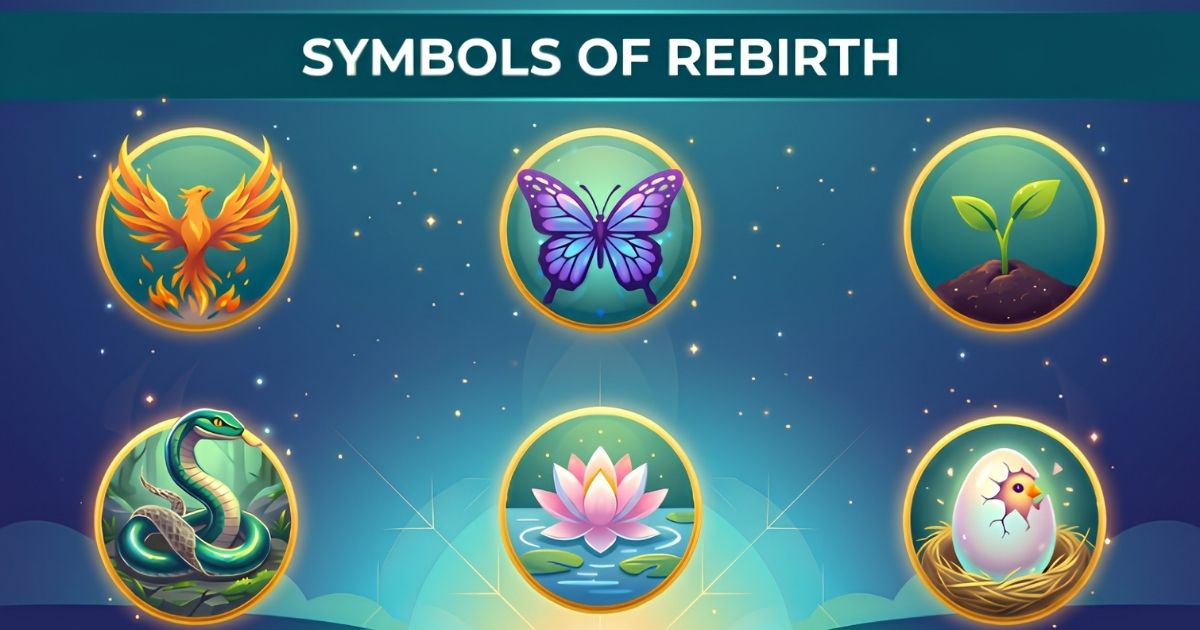

Symbols of rebirth are visual, spiritual, and cultural representations of transformation, renewal, and the powerful cycle of death giving way to new life. You’ve probably seen them your entire life without realizing it. The butterfly on a greeting card. The lotus tattooed on someone’s wrist. The phoenix on a sports team logo. These aren’t just pretty images. They carry thousands of years of human meaning behind them.
People across every culture, continent, and century have used these symbols to make sense of loss, survival, and starting over. Whether you’re going through a personal transformation right now or simply curious about the hidden language of symbols around you, this guide will change how you see the world.
What Are Symbols of Rebirth?
Symbols of rebirth are images, creatures, or natural phenomena that represent renewal, transformation, and life beginning again after destruction or loss. They show up in religion, mythology, tattoos, dreams, art, and everyday nature, often without us even noticing.
It helps to understand the difference between three concepts people often confuse. Rebirth means a complete personal transformation, rising stronger from destruction. Resurrection refers to returning to life after death, often in a religious or literal sense. Reincarnation describes the soul moving into a new body or form after death, common in Hindu and Buddhist traditions. These are related ideas, but they’re not the same thing.
Ancient civilizations didn’t invent these symbols out of thin air. They observed them. They watched seeds crack open in dark soil. They noticed snakes leave their old skin behind. They saw the sun disappear every night and rise again every morning without fail. Over time, these natural observations became powerful cultural symbols woven into religion, art, and storytelling.
Powerful Symbols Of Rebirth And New Beginnings
Some symbols carry stronger rebirth energy than others simply because they’re backed by thousands of years of consistent meaning across multiple cultures. The most powerful ones show up in mythology, nature, and the human body all at once.
Symbols Of Rebirth Tattoos

Tattoos have always been a way to mark something permanent on the outside to reflect something permanent on the inside. Rebirth tattoo symbols are among the most popular choices for people who’ve survived addiction, illness, grief, or major life change. The phoenix, lotus, butterfly, and ouroboros are the top four designs. Placement matters too. A chest tattoo often signals a heart-level transformation, while a forearm tattoo serves as a daily visible reminder of personal growth.
Symbols Of Rebirth Tattoo
A single rebirth tattoo tells a complete story without words. It reflects the exact moment someone chose to stop being defined by their past. The design choice is personal, but the meaning is universal: I went through something that changed me, and I came out different on the other side.
Symbols Of Rebirth And Renewal Tattoo
Renewal tattoos combine elements that suggest ongoing growth rather than a single dramatic transformation. Popular combinations include lotus flowers paired with water, phoenixes surrounded by flames, and butterflies emerging from a cracked chrysalis. Renewal focuses on continuing to grow, while rebirth focuses on rising from a breaking point. Both are powerful, just slightly different in emotional focus.
Symbol For New Beginning And Strength
The strongest symbols of new beginnings and strength are the ones that require destruction first. The phoenix can’t rise without burning. The lotus can’t bloom without the mud. This is exactly why these symbols resonate so deeply. They don’t promise an easy start. They promise that the hard part was worth it.
Spiritual Rebirth Symbol
Spiritual rebirth symbols represent the renewal of the soul rather than just the personality. Sacred circles, the ankh, white light imagery, and the dove appear across multiple faiths as signs of inner awakening. Spiritual rebirth goes deeper than emotional healing. It suggests a complete shift in how a person understands themselves and their place in the world.
Reborn Symbols, Rebirth Signs, and Signs Of Rebirth
The most universal reborn symbols come directly from nature: the egg, the seed, the cocoon, and the bud before it blooms. These feel relatable across every culture because everyone has seen them happen. A cracked egg, a seed pushing through dirt, a cocoon splitting open. These are signs of rebirth hiding in plain sight every single day. Spring itself is arguably the most accessible rebirth sign humans have ever observed.
Ancient And Cultural Symbols Of Rebirth
Ancient cultures didn’t just use rebirth symbolism as decoration. They used it to explain the universe, comfort the dying, and motivate the living. These symbols were embedded into temples, tombs, ceremonies, and daily life.
Things that symbolize rebirth in ancient traditions include fire, water, sacred animals, celestial cycles, and specific plants. What’s remarkable is that cultures with no contact with each other arrived at many of the same symbols independently. Fire destroys and clears the way for new growth in nearly every mythological tradition on Earth.
Symbols of reincarnation specifically, like the spiral, the wheel, and the ouroboros (the snake eating its own tail), represent the endless cycle of life rather than a single transformation. The spiral appears in Celtic stone carvings, Hindu art, and Native American traditions, all pointing toward the same truth: life moves in cycles, not straight lines.
Symbolic rebirth also shows up in ritual. Baptism in Christianity is a symbolic death of the old self and birth of a new spiritual identity. Sweat lodge ceremonies in Native American traditions carry the same theme. The ritual form differs, but the meaning underneath is strikingly consistent across cultures.
Mythological And Religious Symbols Of Rebirth
Spiritual Symbols Of Rebirth and Symbols Of Rebirth In The Bible

The Bible uses water, fire, and light as its core spiritual transformation symbols. Baptism represents dying to sin and rising renewed. The story of Jonah, swallowed and then released from the whale, mirrors the classic death-and-rebirth pattern found in mythology worldwide. Christ’s resurrection is Christianity’s most direct expression of resurrection symbolism.
Pagan and Celtic Symbols Of Rebirth
Pagan rebirth symbols connect deeply to seasonal cycles. The Green Man, a face made entirely of leaves found on medieval church carvings across Europe, represents nature’s ability to regrow. The Celtic Cauldron of Rebirth from Welsh mythology could restore the dead to life, though without their speech, suggesting that rebirth changes you. You don’t come back exactly as you were. The triskelion, three spiraling legs in motion, represents the eternal movement of life through its stages.
African Symbols Of Rebirth
The Adinkra symbol Sankofa from Ghana is one of the most intellectually rich rebirth symbols in the world. Depicted as a bird looking backward while moving forward, Sankofa teaches that you must retrieve wisdom from the past to grow into the future. It’s not about erasing history. It’s about learning from it.
Symbols Of Rebirth In Mythology
Norse mythology gives us Odin, who hung himself on the World Tree Yggdrasil for nine days to gain the wisdom of the runes, a voluntary death-and-rebirth for knowledge. The entire Norse cosmos ends in Ragnarök (catastrophic destruction) and then begins again with a renewed earth rising from the sea. The Aztec corn god Hun Hunahpu was killed and buried, and then sprouted as corn from the earth, directly linking human agriculture and human renewal.
Symbols Of Rebirth In Ancient Egypt and Egyptian Symbols Of Rebirth
Ancient Egyptian rebirth symbols are the most elaborately developed in human history. The scarab beetle represented Khepri, the god of the rising sun, because Egyptians observed beetles rolling dung balls (which they saw as mirroring the sun moving across the sky). The Bennu bird, a sacred heron worshipped at Heliopolis, was the direct ancestor of the Greek phoenix. The Ankh symbolized eternal life. The myth of Osiris, murdered by his brother Set and then resurrected by Isis, became the template for nearly every death-and-rebirth story that followed in Western culture.
The NYT Crossword frequently uses Egyptian rebirth symbols as answers: ANKH, SCARAB, and BENNU are all common entries worth knowing if you’re a puzzle fan.
Famous Rebirth Symbols In Nature And Myth
Phoenix
The phoenix didn’t originate in Greece. It came from the Egyptian Bennu bird and later appeared in Persian mythology as the Simurgh and in Chinese tradition as the Fenghuang. Every version carries the same core truth: destruction is not the end. It’s the condition for something greater. Today, the phoenix appears in the Harry Potter series, X-Men, and the logos of cities like Atlanta and San Francisco, both of which were rebuilt after devastating fires.
Tree Of Life
The Tree of Life bridges time in a way no other symbol does. Its roots represent ancestry and the past. Its trunk represents the present. Its branches reach toward the future. It appears in Norse mythology as Yggdrasil, in Kabbalah as a map of divine energy, and in Celtic tradition as the sacred Crann Bethadh. The tree doesn’t just symbolize rebirth. It symbolizes connection across generations.
Deep Symbolic Meaning of Rebirth
Spiritual Meaning
Spiritually, rebirth represents the soul’s movement toward enlightenment and purification. Most major world religions include some version of this idea, whether it’s the Christian concept of being “born again,” the Buddhist path toward liberation from the cycle of suffering, or the Hindu understanding of moksha, the soul’s final release from reincarnation.
Psychological Meaning
Psychologist Carl Jung described individuation as the process of integrating unconscious parts of yourself into conscious awareness, a psychological rebirth. After trauma, grief, or major life change, people often describe feeling like a completely different person. That’s not metaphor. Neuroscience confirms that intense experiences literally reshape neural pathways.
Cultural Meaning
Cultures use rebirth symbolism collectively after disaster. Japan’s cherry blossom became a symbol of renewal after World War II because its blossoms fall just days after blooming, a reminder that beauty and loss are inseparable. New Orleans residents use the phoenix directly as a symbol of their city’s recovery after Hurricane Katrina.
Types and Variations of Symbols of Rebirth
| Symbol | Origin | Core Meaning | Modern Use |
| Phoenix | Egypt, Greece, Persia | Rising from destruction | Tattoos, sports logos, films |
| Lotus Flower | India, Egypt | Purity rising from suffering | Meditation art, tattoos |
| Butterfly | Universal | Complete personal transformation | Grief symbolism, tattoos |
| Sunrise | Universal | New day, new opportunity | Photography, spirituality |
| Snake (Shedding Skin) | Global mythology | Healing, renewal, hidden wisdom | Medical symbols, dreams |
The butterfly’s symbolism is especially accurate because of what actually happens inside a chrysalis. The caterpillar doesn’t just grow wings. It dissolves almost entirely into a biological soup before reorganizing into a butterfly. That’s not gradual change. That’s complete transformation through dissolution, which is exactly what real personal rebirth often feels like.
The lotus flower closes every night and sinks below the water, then rises and opens again each morning. It does this rooted in mud. The biology makes the symbolism undeniable.
Symbols of Rebirth Across Cultures
- Ancient Egypt: Scarab, Bennu bird, Osiris myth, the daily solar cycle.
- Ancient Greece: Phoenix, Persephone’s seasonal return (explaining winter and spring).
- Hinduism: The Samsara wheel, sacred fire (Agni), Shiva as destroyer and creator.
- Buddhism: The lotus as spiritual evolution, enlightenment as freedom from rebirth.
- Indigenous Cultures: The Eagle in many Native American traditions symbolizes renewal and spiritual vision.
Symbols of Rebirth in Art, Movies and Pop Culture
Rebirth symbolism runs through popular culture more than most people realize. The Lion King follows the classic death-and-rebirth arc: Simba’s father dies, Simba retreats, then returns transformed. The Dark Knight Rises is almost entirely built on phoenix imagery. In literature, the green light in The Great Gatsby symbolizes Gatsby’s endless hope for personal reinvention, a deeply American form of rebirth mythology.
In music, Beyoncé’s Lemonade traces a complete rebirth arc from betrayal through rage, grief, and finally renewal. Johnny Cash’s final American Recordings albums documented a man consciously choosing meaning over decline. Both are cultural rebirth symbols in album form.
Spiritual and Dream Meaning of Symbols of Rebirth
Dreaming of a phoenix or fire often signals that you’re in a period of intense personal transformation, even if you can’t name it yet. Water in dreams represents emotional cleansing and renewal. A butterfly emerging from a cocoon in a dream typically signals a new identity taking shape. Many spiritual traditions treat these dreams not as random but as messages from the deeper self, urging you to release what no longer serves you and step forward.
Positive vs Negative Meanings of Rebirth Symbols
Positive Meanings
Hope, emotional healing, personal growth, spiritual awakening, second chances, resilience, and the courage to begin again.
Negative Meanings
Here’s what most articles skip: rebirth always costs something first. The phoenix burns. The caterpillar dissolves. The lotus grows in mud. Every symbol of rebirth contains a loss at its center. Ignoring the painful side of these symbols makes them feel like greeting card platitudes rather than genuine wisdom. The negative side, destruction, grief, fear of change, is not the opposite of the message. It is the message.
Why Humans Are Drawn to Symbols of Rebirth
Humans are wired to fear permanent endings. Rebirth symbols exist to counter that fear with a different story: nothing is final. Every ending contains the seed of something new. Psychologically, these symbols give suffering narrative meaning, which is one of the most powerful things the human mind can do with pain. When you reframe loss as transformation, you shift from being a victim of change to being shaped by it.
Conclusion
Symbols of rebirth have been part of the human story since the very beginning because the human experience has always included loss, survival, and the stubborn desire to begin again. From the Egyptian scarab carved into tomb walls to the phoenix tattooed on someone’s arm after the hardest year of their life, these symbols carry the same message across thousands of years: you are not finished. The end of one thing is always the beginning of something else. Now that you know how to read these symbols, you’ll start seeing them everywhere, because they were always there, waiting for you to notice.
FAQ’s
What is the most powerful symbol of rebirth?
The phoenix is widely considered the most powerful, appearing across Egyptian, Greek, Persian, and Chinese traditions with a consistent meaning of rising stronger from complete destruction.
What animal symbolizes rebirth and new beginnings?
The butterfly and the snake are two of the most universal. The butterfly transforms completely, while the snake literally leaves its old skin behind and grows a new one.
What color represents rebirth?
Green (new growth), gold (resurrection and light), and white (purity and fresh starts) are the three most common colors associated with rebirth across cultures.
What is the difference between rebirth and reincarnation symbols?
Rebirth symbols represent personal transformation within one lifetime. Reincarnation symbols (spirals, wheels, the ouroboros) represent the soul’s journey across multiple lifetimes.
What does a rebirth tattoo symbolize?
It marks a specific turning point: a moment when a person consciously chose to leave their past behind and start over with a new sense of identity and purpose.
What are the oldest known symbols of rebirth?
The Egyptian scarab and Bennu bird date back over 4,000 years, making them among the oldest documented rebirth symbols in recorded human history.
